New Yorkers have been trying to adjust to the new normal of MTA repairs to tunnels that were flooded by the storm surge from Superstorm Sandy. It included a 15-month closure of the Montague tunnel that affected many living in Brooklyn. There have been scattered closures to other tunnels and rerouted service elsewhere in the subway system, but now comes word that Amtrak is about to do its own remediation of the East River tunnels.
These tunnels service not only Amtrak, but LIRR and NJ Transit. They connect Penn Station with Long Island through the Sunnyside Yards and Harold Interlocking. Amtrak has to take two of the tunnels out of service for a year each. This will reduce the service capacity by 25% (1 out of four tunnels will be out of service at any time during the duration of the project that is expected to start next year).
The reconstruction will be similar to the work done on the Montague tunnels. It will include rebuilding the bench walls that include cable conduits for signals and power, plus railbed replacement and other work that can't be done while the tunnel is active.
The MTA and Amtrak were able to get service restored, but have been seeing an increased amount of service disruptions due to corrosion of equipment in the affected tunnels. That's why this full rehabilitation must get done.
But the East River tunnels are the easy part.
Amtrak has said that they must do the same with the Hudson River tunnels.
There are only two tunnels under the Hudson, and each are over 100 years old. They are functionally obsolete and need major rehabilitation, but that work can't be done until additional capacity is added.
After Gov. Christie cancelled the fully funded ARC tunnel project, that left a gaping hole in capacity expansion. Amtrak proposed a better project, Gateway, that would directly link in with NY Penn Station and allow through trains to run and high speed rail once service improvements elsewhere in the system are made.
Gateway is more than a decade away from seeing the light of day due to lack of funding. So New Jersey residents will be suffering with service delays for the foreseeable future.
Now some will point to Christie being short sighted in his cancellation of the project, but it was the right thing to do because NJ Transit has never met a capital project it couldn't complete overbudget and years after the scheduled deadlines. Cost overruns were likely to be in the $1-2 billion range, and even the FTA warned about the cost containment.
Gateway allows more capacity to the entire system - NJ Transit, Amtrak, and LIRR. ARC would have had limited capacity improvements for NJ Transit since the New York terminus was just that - a terminus. There was no place to store additional trains for rush hour, reducing actual customer capacity on the trains that would run to New Jersey.
The fact that we need to get additional capacity to allow for both growth in customer demand and to fix existing infrastructure is well established. What's missing is the lack of support in New York and New Jersey to find the funding for this critical work. That falls on both Gov. Christie and New York Gov. Andrew Cuomo. Both have shown indifference to mass transit and infrastructure beyond a few car-centric projects like the new Tappan Zee bridge in New York and the Pulaski Skyway rehabilitation and NJ Turnpike expansion projects in New Jersey.
This has to change in order to improve the economic competitiveness of the region against other world-class cities.
Showing posts with label subways and tunnels. Show all posts
Showing posts with label subways and tunnels. Show all posts
Thursday, October 02, 2014
Saturday, December 29, 2012
MTA To Revisit Issue of Platform Screen Doors
Every time we hear someone has been pushed on to the tracks at a station or has been run over by a train, the issue of platform screen doors (PSDs) comes up. These PSDs would prevent someone from falling on to the tracks - either accidentally, or on purpose.
The MTA has been resistant to considering them, primarily because of the immense cost of retrofitting the systems to all 468 stations in the system.
In fact, they weren't being considered for the new stations being built as part of the 7 line extension or the 2d Avenue subway. For those stations, it was estimated that the platform screen doors would add about $1.5 million per platform side.
Up to now, the MTA has resisted the idea of PSDs, but after two homicides in the past week involving people being thrown on to the tracks, the idea is being revisited.
I think it's an issue worth revisiting.
Not only can these doors prevent the senseless deaths due to being shoved on to the tracks, but they can also improve subway efficiency by reducing the amount of trash that collects on the tracks - reducing the chances for track fires, vermin that are attracted to trash, and can improve the air quality on underground platforms.
But that all runs headlong into cost.
It would likely cost $2 billion or more to retrofit the entire system.
That's money the MTA doesn't have and can't even begin to address because of the need to complete repairs due to Hurricane Sandy.
But it is something that should be considered for high volume stations, and stations as they are renovated and rebuilt.

Thursday, September 20, 2012
Governor's Demanded Audit of Port Authority Finds Need For Toll Hikes
The Port Authority of New York and New Jersey recently underwent an outside audit as required by Governors Chris Christie and Andrew Cuomo. They did so because of the fallout over a major toll and fare increase that went into effect earlier this year and follow-on hikes set for the next three Decembers as well as complaints that the agency was diverting funds for transportation projects to finish the World Trade Center project.
The audit report, prepared by the consulting firms Navigant Consulting Inc. and Rothschild Inc., finds that the Port Authority must raise tolls in order to maintain its credit rating and carry out infrastructure maintenance and upgrades over the next decade.
Bridges such as the Goethals and Outerbridge crossing need replacement due to their being functionally obsolete. The Bayonne Bridge must be raised to permit Super Panamax shipping to port facilities.
The George Washington Bridge needs upkeep, including replacing the suspenders that carry the bridge deck weight.
Airport terminals at JFK, LGA, and EWR are 52 years old and contribute to delays and bad customer experiences. The average age for PATH facilities is 72 years, and Port commerce facilities are 57 years old. The increasing age of the facilities means more must be spent to maintain a state of good repair, and that facilities need to be replaced or modernized to maintain competitive advantages over other facilities nationally and around the world.
The full report indicates $3.2 billion in capital construction for airport rehabilitation and improvement projects, focused on Newark Liberty's Terminal A, JFK's Terminal 4 and 5, and LaGuardia's entire terminal infrastructure.
Further, PATH would see another $2 billion in infrastructure projects, including extending rail platforms to accommodate 10-car trains, signal work, and tunnel modernization.
More than $4 billion would be spent on bridge-related projects, though the figure for raising the Bayonne Bridge appears to be 20% higher than the $1 billion costs previously acknowledged for that project. Also, the Goethals Bridge replacement span costs don't appear to show the full cost for that project - which are expected to be financed in a public-private partnership.
The report also indicates a negative free cash flow largely as a result of WTC construction, PATH, Ferry and Port facilities. This situation needs to be addressed all while maintaining the current level of service. At the same time, the bulk of the negative cash flow is the result of WTC construction, which means that the sooner the construction is completed, the sooner that the Port Authority will obtain revenues from WTC related facilities - the office tower rents, retail spaces, and taking construction costs off the books. The ongoing delays in construction have only made the Port Authority's financial situation worse, but it isn't sole reason. The Port's operations incur losses of $28 per container because the revenue stream from tenant rentals is insufficient to cover recurring capital costs, such as dredging and system upgrades. PATH loses about $3 per passenger, which is comparable to other mass transit systems although PATH doesn't get federal subsidies as seen in other mass transit systems.
Aviation facilities are the key generator of Port Authority revenues, with more than $20 in revenue per passenger, while bridges and tunnels generate $7.50 per vehicle.
The audit report, prepared by the consulting firms Navigant Consulting Inc. and Rothschild Inc., finds that the Port Authority must raise tolls in order to maintain its credit rating and carry out infrastructure maintenance and upgrades over the next decade.
The report, prepared by the consulting firms Navigant Consulting Inc. and Rothschild Inc., lays out $26.9 billion in projects the Port Authority is poised to undertake through 2020 — everything from replacing the suspender ropes on the George Washington Bridge to raising the Bayonne Bridge and completing the World Trade Center. But it also identified about $44 billion in needs, including fixing aging terminals at Newark Liberty International and La Guardia airports.The Port Authority is responsible for infrastructure that is in many places approaching 80 years of age or more.
To generate enough revenue to finance those projects, the report recommended that the agency attract private corporations to invest in joint projects and pursue aggressive cost-control measures, some of which Port Authority officials said they recently put in place. Port Authority officials said they would also pursue advertising revenue at its facilities to bring in more non-toll and fare money and would also continue to collect money owed by other government agencies and toll cheats.
The report mounted a strong defense of last year’s toll hikes at the agency’s bridges and tunnels, to $9.50 from $8 during peak travel times. They are scheduled to rise an additional 75 cents each December through 2015. Without those increases, the Port Authority would have had to cut $6 billion from its capital plan over the next decade, imperiling critical projects and its credit rating, the report said. Even with the toll hikes, the report said, the agency is losing money on its bridges, tunnels, trains and bus terminals. The report also encouraged the Port Authority to “educate the public” about tolls on some of the New York City-owned bridges linking Manhattan and its boroughs.
Bridges such as the Goethals and Outerbridge crossing need replacement due to their being functionally obsolete. The Bayonne Bridge must be raised to permit Super Panamax shipping to port facilities.
The George Washington Bridge needs upkeep, including replacing the suspenders that carry the bridge deck weight.
Airport terminals at JFK, LGA, and EWR are 52 years old and contribute to delays and bad customer experiences. The average age for PATH facilities is 72 years, and Port commerce facilities are 57 years old. The increasing age of the facilities means more must be spent to maintain a state of good repair, and that facilities need to be replaced or modernized to maintain competitive advantages over other facilities nationally and around the world.
The full report indicates $3.2 billion in capital construction for airport rehabilitation and improvement projects, focused on Newark Liberty's Terminal A, JFK's Terminal 4 and 5, and LaGuardia's entire terminal infrastructure.
Further, PATH would see another $2 billion in infrastructure projects, including extending rail platforms to accommodate 10-car trains, signal work, and tunnel modernization.
More than $4 billion would be spent on bridge-related projects, though the figure for raising the Bayonne Bridge appears to be 20% higher than the $1 billion costs previously acknowledged for that project. Also, the Goethals Bridge replacement span costs don't appear to show the full cost for that project - which are expected to be financed in a public-private partnership.
The report also indicates a negative free cash flow largely as a result of WTC construction, PATH, Ferry and Port facilities. This situation needs to be addressed all while maintaining the current level of service. At the same time, the bulk of the negative cash flow is the result of WTC construction, which means that the sooner the construction is completed, the sooner that the Port Authority will obtain revenues from WTC related facilities - the office tower rents, retail spaces, and taking construction costs off the books. The ongoing delays in construction have only made the Port Authority's financial situation worse, but it isn't sole reason. The Port's operations incur losses of $28 per container because the revenue stream from tenant rentals is insufficient to cover recurring capital costs, such as dredging and system upgrades. PATH loses about $3 per passenger, which is comparable to other mass transit systems although PATH doesn't get federal subsidies as seen in other mass transit systems.
Aviation facilities are the key generator of Port Authority revenues, with more than $20 in revenue per passenger, while bridges and tunnels generate $7.50 per vehicle.
Thursday, June 07, 2012
What To Do With $70 Billion in Unspent Earmarks
Senator Tom Coburn has announced that the federal government has more than $70 billion in unspent earmarks on its books that must account for. This includes monies that were designated for state and local projects that those localities later chose not to do.
It could secure the financing (or outright pay for) for any number of bridge and tunnel projects and other critical infrastructure projects. That includes air traffic control system upgrades that would boost efficiencies for the airlines and travelers by reducing congestion at airports and reduce the amount of fuel needed to reach any number of destinations. The economic benefits of upgrading the air traffic control system could reach into the billions of dollars annually as flight times are cut by routing planes more directly to their destinations.
It could help fully fund the entire 2d Avenue Subway, which would enable hundreds of thousands of commuters to more easily reach their destinations in New York City. It could fund the replacement spans for the Tappan Zee, Goethals Bridges, or the Pulaski Skyway. It could mean the construction of the Gateway Tunnel and Portal Bridges on the NEC.
It could mean construction of replacement spans for hundreds of deficient bridges, overpasses, and roads around the nation.
It could mean addressing deteriorating conditions of sanitary sewers and water delivery systems.
It could mean addressing funding shortfalls for National Park infrastructure, such as rehabilitating roads, visitor centers, and habitat restoration.
All of these have tangible economic benefits - not only immediate benefits due to construction work and the jobs created, but the long term benefits of improving and maintaining long-neglected infrastructure.
This is one of the major shortfalls of the ARRA of 2009 - it didn't sufficiently address infrastructure work, despite plenty of shovel-ready projects around the nation that would have benefited from the work.
The $70 billion figure is money that's been unspent for years, including $13 billion in road-building money that was earmarked to the wrong places, or for projects that states and localities no longer want to build.That's a small sum of the total federal budget and the ongoing deficit, but it's a not insignificant sum of money that could go to any number of major infrastructure projects around the nation.
In one case Mr. Coburn said $29 million was dedicated to a highway interchange in Newport News, Va., in 1998, but the state abandoned the project. The congressman who sponsored the earmark died in 2000, but the money remains unspent.
In another case Atlanta is still holding onto $2.7 million in funding that was allowed to be spent only on the 1996 Olympics.
"A dollar taken from the taxpayers left unspent is a dollar not needed by the government or a dollar that did not go to someone in need," Mr. Coburn said in a letter accompanying his report. "It represents a failure to budget wisely."
It could secure the financing (or outright pay for) for any number of bridge and tunnel projects and other critical infrastructure projects. That includes air traffic control system upgrades that would boost efficiencies for the airlines and travelers by reducing congestion at airports and reduce the amount of fuel needed to reach any number of destinations. The economic benefits of upgrading the air traffic control system could reach into the billions of dollars annually as flight times are cut by routing planes more directly to their destinations.
It could help fully fund the entire 2d Avenue Subway, which would enable hundreds of thousands of commuters to more easily reach their destinations in New York City. It could fund the replacement spans for the Tappan Zee, Goethals Bridges, or the Pulaski Skyway. It could mean the construction of the Gateway Tunnel and Portal Bridges on the NEC.
It could mean construction of replacement spans for hundreds of deficient bridges, overpasses, and roads around the nation.
It could mean addressing deteriorating conditions of sanitary sewers and water delivery systems.
It could mean addressing funding shortfalls for National Park infrastructure, such as rehabilitating roads, visitor centers, and habitat restoration.
All of these have tangible economic benefits - not only immediate benefits due to construction work and the jobs created, but the long term benefits of improving and maintaining long-neglected infrastructure.
This is one of the major shortfalls of the ARRA of 2009 - it didn't sufficiently address infrastructure work, despite plenty of shovel-ready projects around the nation that would have benefited from the work.
Monday, June 04, 2012
Inside the Second Avenue Subway Construction Site
A video of the construction process, including the tunnel boring machines that are critical to the effort.
It's interesting that they are using one machine, tunneling one bore, and then pulling the machine back to run the second tunnel. That seems to be extremely time consuming and much more costly than had they run two machines simultaneously and allowed the machines to continue running south towards Hanover Square (the 2d Avenue Line's ultimate terminus should it ever be fully funded).
It's interesting that they are using one machine, tunneling one bore, and then pulling the machine back to run the second tunnel. That seems to be extremely time consuming and much more costly than had they run two machines simultaneously and allowed the machines to continue running south towards Hanover Square (the 2d Avenue Line's ultimate terminus should it ever be fully funded).
Saturday, April 28, 2012
Thinking Big: Expanding and Improving NYC Mass Transit
What can be done to improve and expand New York City's subway system, which is already the largest in the US, but which faces tremendous challenges? We already know how difficult it is to reclaim transit options that were previously built - think the Second Avenue Subway, which is finally seeing the first phase underway after decades of promises to replace the elevated line that was demolished from 1940 to 1942.
The 7 Line is seeing an expansion to Hudson Yards, though it wont get all the stations as originally planned. That isn't stopping some, including current MTA Chairman Joe Lhota, from considering future expansion of the 7 all the way to Chelsea Piers (West Side Highway and 23rd Street). Lhota admits that Mayor Bloomberg's proposal to extend the 7 all the way to Secaucus, New Jersey is unlikely while throwing support behind the Gateway tunnel project.
Still, it's not like expansion plans haven't been drawn up in the past. Indeed, they were planning a second system in 1939, to expand the subway by more 40 track miles (about 16% larger than the system now). It called for expanding the subways to the far reaches of New York City, but never happened due to the skyrocketing costs and World War II.
That's a refrain that's been repeated time and again since the bulk of the system was built before 1940.
Another vision of an expanded subway system is here, with detail about how those lines would interact with those that have already been built.
The tremendous costs of building a new subway line are a major impediment to expanding the system. Costs for maintaining and upgrading existing systems sap the ability to build big.
But that shouldn't stop anyone from considering new projects that would enhance the subway system and build new capacity that reduces congestion, pollution, and increases commuter options that aren't based on a Manhattan central business district.
Thus, we need to focus on the outer boroughs, where most New York City residents live and work. The Second System is something of a guide to future expansion, but we'd have to go so much further to address where and how people live, work, and commute to maximize value for the expansion.
We would have to consider current and future demographics.
It means contemplating expanding the 3 further into Starrett City and the Gateway Center commercial district. Such a route could extend from the current rail yard down Elton Street and turn to cross Hendrix Creek to meet up with Van Siclin Avenue and Seaview Avenue before terminating at Pennsylvania Avenue. Stops could be created for both Pennsylvania Avenue (with parking close-by plus buses already accessible to the area) and the Gateway Center. Gateway has multiple restaurants, big box stores, and ample parking.
It means considering the Triboro RX, which would create an outer loop rail system utilizing existing right of way to create an interboro subway line that doesn't force commuters to go through Manhattan.
It means considering extending the 2/3 that terminate at the Junction in Brooklyn (Nostrand and Flatbush) all the way to Kings Plaza.
It means building a true subway connection for Staten Island commuters - one that would like result in a new tunnel beneath the Narrows.
It means providing an additional stop for Roosevelt Island to take advantage of the development of a completely new tech campus on the southern end of the island.
It means finding a way to connect Governor's Island to the subway system to take advantage of this gem hidden in plain view of millions of New Yorkers who can't figure out how to actually get there.
It also means considering light rail and/or separated and dedicated bus lanes for places with high congestion - think Eastern Parkway, Atlantic and Flatbush Avenues in Brooklyn, or Queens Boulevard, Union Turnpike in Queens, the Grand Concourse in the Bronx, and Hylan Boulevard and Victory Boulevard on Staten Island.
None of these proposals are truly new or groundbreaking, but they are worth considering because of the future value they'd bring to the city and its ability to integrate and maximize its real estate.
None of this comes cheaply, and none of this will get done without the political will to not only think big, but to secure adequate capital funding for the MTA that is perpetually behind the 8-ball when it comes to funding.
For its part, the MTA has to demonstrate that it can contain costs on its existing projects and to maximize its limited resources. Cost overruns on the 2d Avenue Line, the 7 Line expansion, and particularly the Fulton Street Terminal are reason for concern.
The 7 Line is seeing an expansion to Hudson Yards, though it wont get all the stations as originally planned. That isn't stopping some, including current MTA Chairman Joe Lhota, from considering future expansion of the 7 all the way to Chelsea Piers (West Side Highway and 23rd Street). Lhota admits that Mayor Bloomberg's proposal to extend the 7 all the way to Secaucus, New Jersey is unlikely while throwing support behind the Gateway tunnel project.
Still, it's not like expansion plans haven't been drawn up in the past. Indeed, they were planning a second system in 1939, to expand the subway by more 40 track miles (about 16% larger than the system now). It called for expanding the subways to the far reaches of New York City, but never happened due to the skyrocketing costs and World War II.
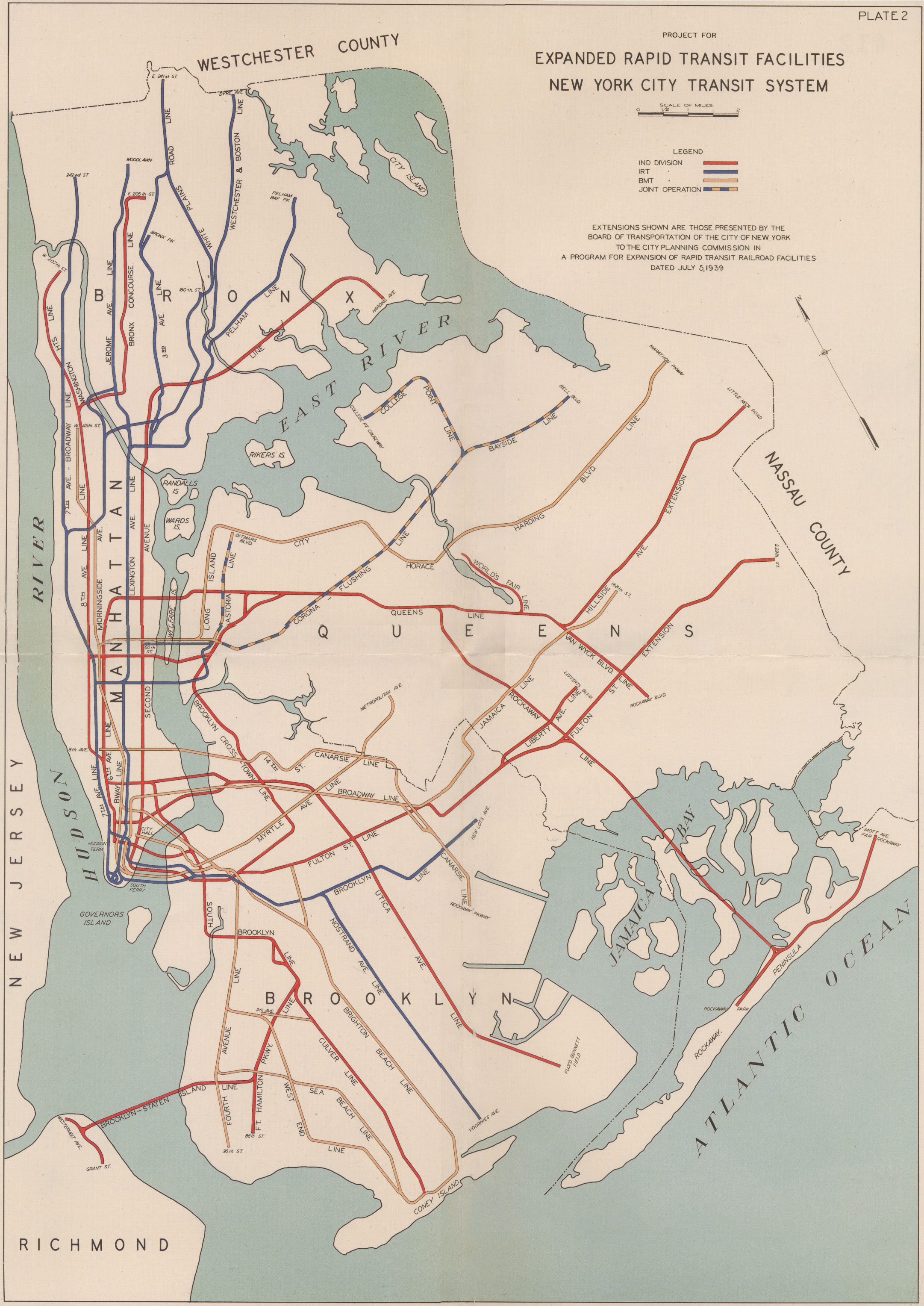
That's a refrain that's been repeated time and again since the bulk of the system was built before 1940.
Another vision of an expanded subway system is here, with detail about how those lines would interact with those that have already been built.
The tremendous costs of building a new subway line are a major impediment to expanding the system. Costs for maintaining and upgrading existing systems sap the ability to build big.
But that shouldn't stop anyone from considering new projects that would enhance the subway system and build new capacity that reduces congestion, pollution, and increases commuter options that aren't based on a Manhattan central business district.
Thus, we need to focus on the outer boroughs, where most New York City residents live and work. The Second System is something of a guide to future expansion, but we'd have to go so much further to address where and how people live, work, and commute to maximize value for the expansion.
We would have to consider current and future demographics.
It means contemplating expanding the 3 further into Starrett City and the Gateway Center commercial district. Such a route could extend from the current rail yard down Elton Street and turn to cross Hendrix Creek to meet up with Van Siclin Avenue and Seaview Avenue before terminating at Pennsylvania Avenue. Stops could be created for both Pennsylvania Avenue (with parking close-by plus buses already accessible to the area) and the Gateway Center. Gateway has multiple restaurants, big box stores, and ample parking.
It means considering the Triboro RX, which would create an outer loop rail system utilizing existing right of way to create an interboro subway line that doesn't force commuters to go through Manhattan.
It means considering extending the 2/3 that terminate at the Junction in Brooklyn (Nostrand and Flatbush) all the way to Kings Plaza.
It means building a true subway connection for Staten Island commuters - one that would like result in a new tunnel beneath the Narrows.
It means providing an additional stop for Roosevelt Island to take advantage of the development of a completely new tech campus on the southern end of the island.
It means finding a way to connect Governor's Island to the subway system to take advantage of this gem hidden in plain view of millions of New Yorkers who can't figure out how to actually get there.
It also means considering light rail and/or separated and dedicated bus lanes for places with high congestion - think Eastern Parkway, Atlantic and Flatbush Avenues in Brooklyn, or Queens Boulevard, Union Turnpike in Queens, the Grand Concourse in the Bronx, and Hylan Boulevard and Victory Boulevard on Staten Island.
None of these proposals are truly new or groundbreaking, but they are worth considering because of the future value they'd bring to the city and its ability to integrate and maximize its real estate.
None of this comes cheaply, and none of this will get done without the political will to not only think big, but to secure adequate capital funding for the MTA that is perpetually behind the 8-ball when it comes to funding.
For its part, the MTA has to demonstrate that it can contain costs on its existing projects and to maximize its limited resources. Cost overruns on the 2d Avenue Line, the 7 Line expansion, and particularly the Fulton Street Terminal are reason for concern.
Tuesday, February 21, 2012
Cronyism Has Always Been Part Of the Port Authority's Problem
Cronyism and patronage jobs have long been a problem at the Port Authority of New York and New Jersey. It's due to the fact that this is a bistate agency where governors of two states appoint key positions and jobs often go to politically connected individuals who may or may not have the skills needed to run an agency tasked with running bridges, tunnels, airports, and ports along with the reconstruction efforts at Ground Zero.
So, I'm a wee bit amused at the fact that there are calls in the New York Times op-ed to end the cronyism at the Port Authority as though this is something new. The writer likes to think that the agency worked well and was largely insulated from political winds blowing in Trenton, Albany, and New York City but that glosses over that the authority's focus and direction remains at the whim of the political leaders in charge at the Port Authority who get their working orders from their respective political masters.
The situation has gotten noticeably worse as the states are constrained from building and rebuilding infrastructure because their tax base can't be grown further and they can't issue debt in the way that they used to; they are increasingly reliant on the Port Authority's tolling ability to fund new and expanded projects across the region.
The only way to rein in the Authority's patronage is to limit the scope of the Authority's operations and to require that the Authority funding go to Authority projects only. The Port Authority shouldn't be in the business of real estate and it should be forced to divest itself of the World Trade Center responsibilities - and to scale back the PATH terminal there that has gone overbudget by nearly $2 billion from its original projections. It should be in the business of maintaining its bridges and tunnels, port operations, and airports, and it's not doing a sufficient job on any of these projects.
There are key projects that must be accomplished to maintain the region's dominance in international trade and infrastructure - raising the Bayonne Bridge, replacing the Goethals Bridge, upgrading terminals at all three regional airports and expanding operations at Stewart Airport, and carrying out improvements to the George Washington Bridge. There is also the deferred plans to build a new parking garage for buses heading to the Port Authority Bus Terminal that would reduce congestion around the Terminal and improve air quality in the vicinity due to not forcing buses to idle waiting to get into the terminal or driving back to New Jersey empty because of a lack of capacity on the New York side.
These projects are at the core of the Authority's mission, and yet political leaders are eyeing the Port Authority for other purposes. That's got to end and the Authority must focus on doing what it's supposed to do.
Thursday, February 16, 2012
Construction Accident At 4WTC Resulting in Subway Service Diversion On 1 Line
A crane lifting a load on 4WTC apparently suffered some kind of problem and the load dropped 40 stories to an area that is off-limits.
As they say, developing....
UPDATE:
I've had an opportunity to go by the site. As these photos at Gothamist indicate, the crane dropped the load 40 stories on the NW corner of the 4WTC site. This puts the accident close to the SE corner of the WTC Memorial but no damage was done to either the memorial or the 4WTC building itself.
Work on 4WTC appears to have been stopped and the crane wire appears to have snapped off near the top of the tower. After the series of crane accidents a few years ago, inspections were stepped up around the city to prevent further accidents. One avenue of the investigation into this accident will be whether inspection schedules were followed and whether the weather or other factors played a role in the accident.
I had heard a crashing and thunderous booming sound around the time of the accident, but didn't give it much heed (we get various construction noise at my location all the time) although the sound of emergency vehicle sirens did ring out a short time later.
The load plunged some 40 stories. Debris fell into a closed-off area of the construction site after the crane’s cable snapped.4WTC is expected to be completed and ready for occupancy at the end of 2013. It's not clear whether the crane accident will delay construction.
The Fire Department says some of the beams fell on an unoccupied trailer. A construction worker nearby was looked at by emergency responders, but was not taken to the hospital.
Number 1 train service is suspended south of Chambers Street.
The incident took place at about 10 a.m. near Church and Cortlandt Street.
As they say, developing....
UPDATE:
I've had an opportunity to go by the site. As these photos at Gothamist indicate, the crane dropped the load 40 stories on the NW corner of the 4WTC site. This puts the accident close to the SE corner of the WTC Memorial but no damage was done to either the memorial or the 4WTC building itself.
Work on 4WTC appears to have been stopped and the crane wire appears to have snapped off near the top of the tower. After the series of crane accidents a few years ago, inspections were stepped up around the city to prevent further accidents. One avenue of the investigation into this accident will be whether inspection schedules were followed and whether the weather or other factors played a role in the accident.
I had heard a crashing and thunderous booming sound around the time of the accident, but didn't give it much heed (we get various construction noise at my location all the time) although the sound of emergency vehicle sirens did ring out a short time later.
Friday, October 28, 2011
Happy Birthday NYC Subways!
On this day in 1904, the NYC subway system opened its first line.
It is now the nation's largest transit system (carrying more passengers than nearly all other transit systems in the nation combined, and that separates out the SI Railway which is part of the MTA and PATH, which runs service in and out of Manhattan).
The MTA subways are the 6th most used system in the world (Tokyo is first), but it has more stations and track miles than nearly every other system on that list.
Since that first line in 1904, the system has grown by leaps and bounds, but no new transit lines have been built in decades. That's changing with the construction of the 2d Avenue Subway, which is actually a long-overdue replacement of an elevated subway line that ran along much of 2d Avenue until it was torn down.
The 7 Line is getting a needed extension to the far West Side, and may eventually burrow across the Hudson River to join up with the Secaucus Transit hub and NJ Transit.
There's lots of other work to be done, but the complexity of the system and that it operates 24/7/365 means that work that other systems could carry out overnight has to be staggered in such a way that it increases the time to complete. Such is the benefit and cost of running such a massive system.
One can only hope that the local and state politicians do a better job of supporting mass transit and the subway system, which remains the heart that pumps the New York City economy.
Friday, August 19, 2011
Welcome to the Real World: Port Authority Gets Its Fare/Toll Hikes After Brokered Deal With Cuomo and Christie
As I have been warning, the Port Authority is getting its toll hike. Governors Chris Christie and Andrew Cuomo got the political cover they needed. Commuters got stuck with the bill.
The original proposal was unusually steep so as to make the Governors' proposal appear to be far more reasonable. Yet, it still represents real money that commuters will be forced to shell out. The new PATH fares will rise to $2 in September, and then by 25 cents each year after through 2015 ($2.75). That's likely to work out to a $10 a month increase on 40-trip pass. It also moves PATH closer to the MTA bus and subway fare parity, although PATH users do not have free transfers to the MTA system.
Where I can find agreement with the governors and Port Authority is that they impose additional penalties on all motor vehicles that do not use EZ-Pass. However, the Port Authority must do a better job making sure that those drivers who have EZ-Pass are not inconvenienced by the backup of drivers at the cash lanes as is all too frequent a problem. Increased use of EZ-Pass can help reduce congestion and pollution at toll plazas, but if the cash lanes back up, it can mitigate any congestion reductions caused by EZ-Pass use.
UPDATE:
The Port Authority board unanimously adopted the governors' proposed toll hikes. They will take effect in September.
Under the new plan, E-ZPass tolls would be raised in September to $9.50 a ride at peak hours, from $8, on the George Washington Bridge, the Holland and Lincoln Tunnels, and three other crossings to Staten Island.Both New York and New Jersey need the Port Authority to continue handling infrastructure improvements in the New York City metro area because both states' fiscal situation and taxpayer discontent isn't conducive to broad based tax hikes to support mass transit or infrastructure improvements. Thus, it was left up to the Port Authority to impose the higher charges.
Drivers who pay with cash would face a 50 percent increase in September, to $12 a ride, from $8. Tolls would then rise by 75 cents more a year through 2015, with cash tolls rounded up to the nearest whole dollar.
The less-stringent increases are expected to be approved by the Port Authority’s board of commissioners at a meeting on Friday.
The authority had proposed a $4-a-ride increase for E-ZPass users next month, drawing criticism from drivers and some politicians — including, somewhat incongruously, Gov. Andrew M. Cuomo of New York and Gov. Chris Christie of New Jersey, who jointly control the agency.
Toll increases at the Port Authority are often highly choreographed affairs, and few transportation groups expected the initial proposal to remain unchanged. Both governors had said they were surprised at the steepness of the initial proposal, although their administrations were made aware of the plan before it was publicly announced.
The original proposal was unusually steep so as to make the Governors' proposal appear to be far more reasonable. Yet, it still represents real money that commuters will be forced to shell out. The new PATH fares will rise to $2 in September, and then by 25 cents each year after through 2015 ($2.75). That's likely to work out to a $10 a month increase on 40-trip pass. It also moves PATH closer to the MTA bus and subway fare parity, although PATH users do not have free transfers to the MTA system.
Where I can find agreement with the governors and Port Authority is that they impose additional penalties on all motor vehicles that do not use EZ-Pass. However, the Port Authority must do a better job making sure that those drivers who have EZ-Pass are not inconvenienced by the backup of drivers at the cash lanes as is all too frequent a problem. Increased use of EZ-Pass can help reduce congestion and pollution at toll plazas, but if the cash lanes back up, it can mitigate any congestion reductions caused by EZ-Pass use.
UPDATE:
The Port Authority board unanimously adopted the governors' proposed toll hikes. They will take effect in September.
Thursday, August 18, 2011
Port Authority Closing In On Fare and Toll Hikes Despite Scathing Audit
Expect the Port Authority to go ahead and approve fare and toll hikes Friday even though New York State Comptroller Tom DiNapoli issued a scathing audit finding that the Port Authority spent nearly $100 million on overtime, and that its average salary was well over $90,000 - and that includes its entire police force, which patrols bridges, tunnels, ports, and airports. Overtime flows like water.
Part of the overtime conundrum is the result of the agency employing fewer people and requesting those that are on the payroll to do more. However, it appears that there's few hurdles to enabling PAPD officers from running up overtime that matches their base salaries.
The agency held hearings earlier this week, where it got an earful from commuters complaining about the 50%+ toll hike and a nearly 60% hike on PATH fares. It's almost a given that fares and tolls will rise, but it may come down to whether Gov. Andrew Cuomo and Gov. Chris Christie will limit the hikes what I expect to be half what the agency wants.
Christie is being coy about his position, mostly because it is New Jerseyeans who will bear the brunt of the costs, particularly at the bridges and tunnels between New Jersey and Manhattan.
One way to deal with Port Authority payroll issues is to eliminate the Port Authority police force and delegate the tasks to local police instead. As it is, the Port Authority has regular issues with NYPD interactions regarding security at Ground Zero and the World Trade Center complex before that. Memorandum of understandings have been issued from time to time setting out who is responsible for what, even though the facility is located in New York City. Let the NYPD patrol, and you can generate savings in that fashion. It can make the chain of command and responsibility for security far more difficult than it ought to be, but the Port Authority has its own fiefdom to protect.
The security can be picked up by New Jersey State Troopers or New York State Troopers at other border crossings, including the ports and airports.
Infrastructure improvements need to be fully funded, and key items need to be upgraded, but the Port Authority is also full of waste and projects it oversees have gone over budget, none more spectacularly so than the PATH transit hub at Ground Zero. Despite claims that it would contain costs, it has gone more than $1 billion over budget.
The agency paid $85.7 million in overtime last year to 5,360 of its 6,977 employees, an audit by New York State Comptroller Thomas DiNapoli found. The audit concluded that the agency failed to rein in extra pay, citing dozens of employees who made more in overtime than they did in base salary.
“Management has no clear strategy to achieve its own benchmarks and goals for curbing costs,” DiNapoli said. “Before the Port Authority asks for more money to fund its operations, the agency should take a long, hard look at whether its business model for managing overtime really makes sense.”
The agency issued a brief statement in response.
“The Port Authority just received this report and we take it very seriously,” agency officials said in a statement. “We will continue to cut costs and make sure we value every dollar as we work to meet the region’s needs.”
Part of the overtime conundrum is the result of the agency employing fewer people and requesting those that are on the payroll to do more. However, it appears that there's few hurdles to enabling PAPD officers from running up overtime that matches their base salaries.
The agency held hearings earlier this week, where it got an earful from commuters complaining about the 50%+ toll hike and a nearly 60% hike on PATH fares. It's almost a given that fares and tolls will rise, but it may come down to whether Gov. Andrew Cuomo and Gov. Chris Christie will limit the hikes what I expect to be half what the agency wants.
Christie is being coy about his position, mostly because it is New Jerseyeans who will bear the brunt of the costs, particularly at the bridges and tunnels between New Jersey and Manhattan.
One way to deal with Port Authority payroll issues is to eliminate the Port Authority police force and delegate the tasks to local police instead. As it is, the Port Authority has regular issues with NYPD interactions regarding security at Ground Zero and the World Trade Center complex before that. Memorandum of understandings have been issued from time to time setting out who is responsible for what, even though the facility is located in New York City. Let the NYPD patrol, and you can generate savings in that fashion. It can make the chain of command and responsibility for security far more difficult than it ought to be, but the Port Authority has its own fiefdom to protect.
The security can be picked up by New Jersey State Troopers or New York State Troopers at other border crossings, including the ports and airports.
Infrastructure improvements need to be fully funded, and key items need to be upgraded, but the Port Authority is also full of waste and projects it oversees have gone over budget, none more spectacularly so than the PATH transit hub at Ground Zero. Despite claims that it would contain costs, it has gone more than $1 billion over budget.
Friday, August 12, 2011
ARC Tunnel Was No Panacea To Ongoing NJ Transit and Amtrak Delays
This past week has been a horror show for commuters along the Northeast Corridor and other train lines into New York Penn Station. A supposed minor derailment led to massive delays that lasted more than 24 hours and a further minor derailment in Sunnyside Yards led to additional delays.
Then, this morning signal problems led to still more delays.
All these problems have apparently resurrected calls to build new tunnels into Manhattan or otherwise castigate New Jersey Governor Chris Christie for cancelling the ARC Tunnel project.
I doubt any of these people actually reviewed the ARC tunnel project and knew how the tracks and station were configured.
Had they done so, they would have realized that the new tunnel project would have succumbed to exactly the same kinds of delays. In fact, it would have likely resulted in even greater delays.
ARC would have built 2 single track tunnels to a new station underneath Herald Square that had multiple platforms. That means that all the tracks would have had to funnel into one track for each direction. Considering that the derailment was in the same kind of location - a choke point - a derailment within the ARC tunnel project would have resulted in the same kinds of delays.
Actually, the delays could have been far worse. You see, the ARC tunnel station had no space to store additional trains. At New York Penn Station, out-of-service trains are stored in Sunnyside Yards in Queens. The ARC station had no such facilities or access, meaning that a derailment would have blocked multiple track platforms and once any trains sitting in the station could be moved out, there were no additional trains that could be brought in in a timely fashion. It would have increased delays, and meant that commuters would have to shuffle over to New York Penn Station and hope that NJ Transit could have equipment in place to handle the overflow.
As we've seen, NJ Transit has been incapable of handling overflow situations, even where the track capacity is available. If it doesn't have equipment in the right place at the time, you'd still get the massive delays.
In other words, Gov. Christie was correct to kill the ARC tunnel, which was the wrong answer to a big question - how to get more commuter and high speed trains into New York. The Gateway proposal is a better setup as it increases tunnel capacity into New York Penn directly, along with the Sunnyside Yards. It would enable high speed rail for Amtrak, and better handle delays or breakdowns along the NEC.
Gateway is the solution to the question, not ARC.
Tuesday, August 09, 2011
NJ Transit Must Be Held Accountable For Today's Massive Delays
NJ Transit had what it later described as a minor derailment during this morning's rush hour. What it called a minor derailment caused massive delays throughout both the morning and evening rush hours. In fact, the delays spilled over to rail lines that should never have been affected but for the agency's massive failures.
There was no reason for the kinds of delays seen on the train lines running out of Hoboken. There was a time when Hoboken could handle traffic from the Midtown Direct trains and all of its existing rail lines (Bergen/Main, Pascack, Montclair-Boonton, and other lines) without succumbing to the delays seen today. In fact, there was more train traffic just a few years ago before NJ Transit cut service.
That goes to the incompetence of the agency to deal with the derailment.
Why couldn't the agency make the necessary repairs from what it considered a minor derailment in time for the evening rush hour? Why did it delay making repairs until after 8pm tonight, rather than trying to get everything fixed in time for the evening rush hour? Delays may have eased on the Bergen/Main line, but can riders expect a normal commute in the morning?
I doubt it.
Those are mistakes that cost riders real time and money and countless hours of aggravation.
NJ Transit deserves all the scorn and derision one can muster for its awful performance once again. It belatedly admitted that there was a derailment on the NEC; had it done so from the outset, commuters who know better than to trust agency pronouncements about delays would know better than to contemplate traveling altogether and/or preparing for a real long commute. Instead, it stuck to claims that there were 60-90 minute delays on the NEC and NJCL, while 15-20 minutes on the other lines. Problem is that the Bergen-Main line delays were self inflicted with extra time spent waiting at Secaucus for trains that were supposedly canceled or not operating.
It's absolutely inexcusable.
Meanwhile, all the talk about how the Gateway/ARC tunnel would have alleviated this mess is ignoring the fact that NJ Transit is hopelessly incapable of informing riders of delays or resolving problems in a timely manner. It has cut train service into Hoboken and yet it was forced to cancel trains on unaffected lines for no reason. It couldn't find train crews to man trains that were fully loaded. Those have nothing to do with Gateway or the lack of new tunnels, and everything to do with failure of management to deal with contingencies that it knows are likely.
It acted as though this was the first time that there have been problems on the NEC; when it's had problems on a weekly basis. You can't solve those problems with new tunnels alone - and with NJ Transit showing itself to be a poor steward of its capital program, the $1 billion in expected cost overruns for the ARC tunnel were going to seem like rosy projections. NJ Transit couldn't afford ARC, neither could taxpayers, and commuters would have had to shell out even more outrageous fares to cover the agency's multiple failures.
Another Day, Another Major Delay on the Northeast Corridor
Once again, the Northeast Corridor (NEC) is hit with major delays as a NJ Transit train derailed in the Hudson River tunnels between Secaucus and NY Penn Station.
The first we heard of problems was as our Bergen Line train approached Secaucus and conductors warned that there was no inbound traffic to New York so that everyone would be diverted to Hoboken.
NJ Transit first claimed that there was a signal problem before indicating that there was a disabled train causing the delays at 8:12AM. That was followed by a notice at 8:22 that there was a disabled train and 30-60 minute delays.
That's not entirely true as NJ Transit is canceling trains up and down the NEC and other lines that feed through the Hudson River tunnels, so your delays could potentially be much more severe.
NJ Transit hasn't updated to note that a train has derailed. For that, I had to check other news outlets. It turns out that two railcars on an outbound NJ Transit train from Penn Station derailed, snarling traffic through the system. 300 people were on board the derailed train, but there's no word of injuries.
Why is it that the NJ Transit alerts page is last to know what's going on?
The agency recently announced the results of a customer satisfaction survey, and the harsh reality is that the agency has failed on dealing with delays and service disruptions and today's events reinforce the fact that the agency has learned nothing from its prior issues to better distribute news of disruptions and what to do in a timely fashion.
The Twitter feed is furiously slamming the agency for not getting the job done - not informing riders of the disruptions in a timely fashion and ruining yet another commute.
UPDATE:
It's after 1PM local time and the transit agency has no idea whether they can resolve the derailed train and restore full service by the afternoon rush hour, but that news didn't come from the NJ Transit site - it came from NJ.com. They've still got a notice on their site that there are 60-90 minute delays due to a disabled train posted at 9:49AM and that other agencies are cross-honoring tickets.
Thursday, July 28, 2011
MTA Hits Up New York City For $250 Million To Continue Capital Projects
The MTA, which announced its intentions to raise fares twice in the next few years has now gone with hat in hand to New York City to ask for $250 million to complete two of the big capital projects that are still underway: the Second Avenue Subway and the East Side Access project.
The agency's theory is that with real estate taxes likely to rise after the projects are completed, the City would recoup any outlays and then some. In effect, this is essentially a roundabout call for tax increment financing to get the deal done (leveraging future tax revenues to pay for capital projects).
The problem is that the City doesn't exactly have the money to spare, and neither does the state. These projects must get completed and delays end up costing everyone billions more down the road.
However, the MTA needs to show that it can control costs on its capital projects better than it has done to date. Had it been able to keep within budget on existing projects like Fulton Street, the 2d Avenue Subway or the South Ferry projects, the agency would have had sufficient funds available to complete the two other projects with money to spare.
This goes back to the way that the projects are bid and calculated but highlights a further need to contain costs within the capital budget to make sure that critical projects are completed on budget and on time.
Wednesday, July 27, 2011
MTA Proposing Fare Hikes For 2013 and 2015 In Light Of Reduced Support From Albany
The MTA is proposing fare hikes for both 2013 and 2015 in light of the fact that the nation's largest transit agency is facing a shortfall in its budget and the state is not providing as much support as it did just a few years ago.
The agency has spent the past couple of years trying to cut out dead-wood and reduce its workforce, but it's still working against ongoing maintenance needs and projects that continue to go over budget.
The fare hikes would be 7.5% in 2013 and likely a similar percentage in 2015.
Part of the problem stems from the highly distasteful payroll tax that never brought in the kind of revenues envisioned. The budget shortfalls also were due to reduced real estate transfer tax revenues during the recession, but those payments are starting to come back to pre-recession levels.
What the MTA needs is to better address capital construction budgets to keep costs down and more support from Albany to make sure that the transit system remains the premier system in the world - and one whose subway system operates 24/7.
The agency has spent the past couple of years trying to cut out dead-wood and reduce its workforce, but it's still working against ongoing maintenance needs and projects that continue to go over budget.
The fare hikes would be 7.5% in 2013 and likely a similar percentage in 2015.
The MTA budgeted the hikes as part of its five-year financial plan, which the brass will bring to the agency board today for review.Fare hikes continue to hit the working class hardest and they're in the position least capable of absorbing the incessant fare hikes. It may well drive some off mass transit altogether as they consider the costs of driving directly to work locations preferable to dealing with a scheduled timetable (particularly for those on Metro North or LIRR).
Even with the hikes, the agency's fiscal situation remained grim.
There's a $54 million shortfall for the 2014 budget, while 2015 -- the year the newly announced fare hikes will take effect -- is still $178 million in the red, according to the preliminary budget.
The MTA will also try to draw out deep concessions from its unionized workforce, demanding that employees forgo raises for three years -- saving $347 million by 2015.
But the Transport Workers Union -- which represents the majority of MTA workers -- has repeatedly said they will not forgo cost-of-living raises.
The MTA also yesterday announced a complicated funding formula to replenish the funds in its capital budget, which includes asking the feds to loan it $3 billion.
Most of that dough will go toward a massive project to bring the LIRR into Grand Central Terminal.
Part of the problem stems from the highly distasteful payroll tax that never brought in the kind of revenues envisioned. The budget shortfalls also were due to reduced real estate transfer tax revenues during the recession, but those payments are starting to come back to pre-recession levels.
What the MTA needs is to better address capital construction budgets to keep costs down and more support from Albany to make sure that the transit system remains the premier system in the world - and one whose subway system operates 24/7.
Wednesday, July 06, 2011
The Rebuilding of Ground Zero, Part 142
There's been a minor setback on the site of WTC 2, which is located on the northeast corner of the site. Inspectors discovered that the tower crane that was being installed there had a crack in a structural member. It hasn't been put in service and the public is not affected by the crane; it was discovered during routine inspections put in place following a series of high profile crane accidents that killed several people a few years ago.
The crane may be repaired on site, but if that isn't sufficient, an alternative plan is being submitted to the Department of Buildings.
Meanwhile, the retail real estate business in Lower Manhattan is booming ahead of the rebuilding at Ground Zero. Part of that is due to the expected opening of 1WTC and pent up demand for retail space and an improving real estate and business environment in Lower Manhattan. Rents are up and businesses are looking at new expanded and renovated space in the World Financial Center in coming years as well as the retail space inside the World Trade Center's transit hub and connectors.
Work is also progressing on the N/R train station at Cortlandt Street. It was heavily damaged in the 9/11 attacks and was briefly reopened for a time before being closed again to accommodate construction of the Dey Street connector between the PATH Transit Hub and the Fulton Street Transit Hub. Workers hope to have the station reopened in time for the 10th anniversary of the 9/11 attacks this September as they expect the station to handle 300,000 customers daily. To put that number in perspective - that number is more than double the number that uses the Cleveland transit system handles (300,000x365 gives 10.65 million versus 5.2 million customers), but puts it in the middle of the pack among top stations in the NYC subway system.
Monday, June 27, 2011
Second Avenue Subway In Jeopardy Over Lack of Financing
Once again, the oft-delayed Second Avenue Subway is in jeopardy for lack of financing to complete critical contracts for stations along the right of way. Contracts to build out subway stations at 72nd Street, 86th Street, and 96th Street are pending, and the MTA lacks the funds to make that happen.
The state legislature recessed without appropriating any additional money for the project (including for a payroll tax), which means that the MTA and taxpayers will once again have a tunnel to nowhere as happened the last time that the MTA attempted to get the project underway in the 1970s. Then, as now, the MTA was able to build a stretch of tunnel, but the project had to quit after the money ran out.
New York City and the state have reduced funding for the MTA over the past decade, and the MTA has not exactly been a good steward of its projects as costs have spiraled out of control on other key projects. Indeed, the bridges that the MTA oversees are in poor shape, and toll hikes that were meant to improve both mass transit and bridge conditions haven't reaped the promised improvements - particularly so for bridges and tunnels the condition of which is quite poor.
With the financing problems, perhaps the folks on the Upper East Side who are complaining about the dust and construction will find a much improved situation when the money runs out.
Monday, May 09, 2011
Troublesome Security at Rail Tunnels Despite Warnings
This past weekend saw a spate of rail security related incidents that are quite troubling despite years of warnings about inadequate security. Al Qaeda has made it long known that it hoped to attack rail targets around the world, having carried off major attacks in Madrid and London. With the bin Laden raid, the US gathered still more intel about al Qaeda's plans to attack US rail targets perhaps to coincide with the 10th anniversary of the 9/11 attacks.
So the fact that a person was arrested trespassing well into one of the PATH tunnel this weekend, and another group of four people were arrested trespassing in the newly built sections of the Second Avenue subway shows an ongoing problem with security at these tunnels and subway systems. The four arrested in the Second Avenue subway tunnel were carrying Roman candles and were hoping to use the lights to take photos.
However, it's the trespassing incident in the PATH tunnel that is perhaps the more troublesome incident:
Still, rail security has lagged security efforts for air travel and random bag searches are the primary security screening measure for PATH and subways, particularly in the NYC metro area. The report doesn't indicate which subway station Rodruguez entered in Manhattan to begin his trek - as it could have been either the WTC station or Christopher street, but either way, he took his life into his own hands as a train could have come through those tunnels without much warning.
Sen. Chuck Schumer has proposed a no-use list for comparing Amtrak passenger manifests with no-fly lists used by airlines, but that's only a fraction of the passengers who use mass-transit systems nationally. It's a good start but there's no comparable lists for the hundreds of thousands of people who take commuter rail systems like NJ Transit, Metro North, or LIRR (in the NYC metro area alone) let alone subway systems like PATH or the NYC subways.
Consider that around 1.5 million people take flights in the US daily. The NYC subways handles more than 5 million daily. PATH handles another 240,000 per weekday.
That's just the millions who ride mass transit systems in the New York City metro area. The situation is even more daunting for mass transit systems nationally.
Yet, considering that PATH and NYC subways have been repeatedly targeted by active terror plots that were thwarted, the ability for individuals to enter the tunnels unauthorized is quite troubling and points to failures to secure those tunnels properly.
So the fact that a person was arrested trespassing well into one of the PATH tunnel this weekend, and another group of four people were arrested trespassing in the newly built sections of the Second Avenue subway shows an ongoing problem with security at these tunnels and subway systems. The four arrested in the Second Avenue subway tunnel were carrying Roman candles and were hoping to use the lights to take photos.
However, it's the trespassing incident in the PATH tunnel that is perhaps the more troublesome incident:
Officials said Reymundo Rodriguez, 20, of Bayonne, NJ, had hopped down onto the tracks in a Manhattan PATH tunnel. The station was being patrolled by two Port Authority cops.PATH has been repeatedly targeted by al Qaeda and jihadi groups, including a plot to bomb the tunnel so as to cause flooding within the World Trade Center complex. The Port Authority has undertaken some efforts to bomb-proof the tunnels to minimize the chances of a ruptured tunnel flooding the World Trade Center, but significant damage could still occur.
Rodriguez then walked the two miles to Jersey City.
A PA contractor, Lee Anderson, spotted him exiting at around 3 a.m. and called police.
"I just put a bomb down on the tracks," Rodriguez allegedly told officers.
The tunnel was shut down while the Joint Terrorism Task Force and bomb-sniffing dogs searched for a device.
Anderson told cops, "I asked him what he was doing in the tracks, and he said, 'The train never came . . . so I decided to walk,' "
Rodriguez also allegedly told him he saw President Obama on TV, "and he told me it was safe to walk through the tunnel."
Still, rail security has lagged security efforts for air travel and random bag searches are the primary security screening measure for PATH and subways, particularly in the NYC metro area. The report doesn't indicate which subway station Rodruguez entered in Manhattan to begin his trek - as it could have been either the WTC station or Christopher street, but either way, he took his life into his own hands as a train could have come through those tunnels without much warning.
Sen. Chuck Schumer has proposed a no-use list for comparing Amtrak passenger manifests with no-fly lists used by airlines, but that's only a fraction of the passengers who use mass-transit systems nationally. It's a good start but there's no comparable lists for the hundreds of thousands of people who take commuter rail systems like NJ Transit, Metro North, or LIRR (in the NYC metro area alone) let alone subway systems like PATH or the NYC subways.
Consider that around 1.5 million people take flights in the US daily. The NYC subways handles more than 5 million daily. PATH handles another 240,000 per weekday.
That's just the millions who ride mass transit systems in the New York City metro area. The situation is even more daunting for mass transit systems nationally.
Yet, considering that PATH and NYC subways have been repeatedly targeted by active terror plots that were thwarted, the ability for individuals to enter the tunnels unauthorized is quite troubling and points to failures to secure those tunnels properly.
Monday, February 07, 2011
Sens. Lautenberg and Menendez Attempt To Resuscitate Trans-Hudson Tunnel Project
After Gov. Chris Christie killed the ARC tunnel project because New Jersey taxpayers would be on the hook for all cost overruns, and it was already estimated to go $1 billion over the $8.7 billion budget, Sen. Frank Lautenberg was among Christie's harshest critics. He complained about how commuters would be harmed by the loss of a key project.
Never mind that Christie was absolutely right to protect taxpayers from a project that would benefit New Jersey and New York, but put the entire risk of overruns on New Jersey while New York contributed no funds to the project. Even federal efforts to keep the project on track amounted to nothing more than additional loan guarantees to cover a portion of cost overruns.
The project, which was originally proposed as a $5 billion project, had already ballooned to $8.7 billion, and the most conservative estimate for overruns was $1 billion beyond that amount. Other estimates could have pushed the New Jersey share to $5 billion.
So, now Lautenberg and Menendez are back touting that they've got another plan to build a trans-Hudson river rail tunnel.
This time, they've got Amtrak on board with the proposal, and it would lead to an expanded Penn Station, rather than a dead-ended annex under Herald Square.
The cost of the project is still huge, and they expectation is that the tunnel will run $10 billion or more, but the issue will be who will cover what costs. With Amtrak involved this time, there will be additional cost sharing, and this proposal shows that the NJ Transit claim that the new tunnels could not be built to Penn Station were nothing but bureaucratic domain protection. It wasn't based on anything but NJ Transit trying to expand its own infrastructure at tremendous cost even though the agency's operating budget is incapable of handling the existing traffic.
NJ Transit's dealing with an aging infrastructure and an operating budget that can't cover the existing schedule. I have serious doubts over its scheduling claims from North Jersey when there have been a reduction in train service, and debt service on the Secaucus Transfer continues to be a drain all while the proposed tunnel would include a Transfer bypass allowing trains to travel directly into Manhattan from North Jersey. That would severely limit the ridership that would utilize the Transfer unless the existing parking facilities are greatly expanded.
What remains to be seen is who will be paying for what and what the New Jersey share will be. Moreover, the key questions will be whether New York actually ponies up any funds to cover construction costs, and who will bear the risk of cost overruns.
This new project is already starting at a much higher price point, and it's more than double the original ARC tunnel cost projection.
UPDATE:
I wonder if the costs for the new tunnel project are including the Portal Bridge costs, which at last check was a totally separate and distinct project that was scheduled to cost $1.344 billion. Construction is scheduled to begin next year and run through 2017 in building two new bridges and five tracks to handle traffic on the Northeast Corridor as well as reconfigure about 10 miles of track between Newark and Secaucus Transfer to handle high speed rail (80-90 mph, from the current 60 mph limitations). That work has to be done regardless of what happens with the tunnel project, and monies were already set aside by Amtrak, the ARRA of 2009, and other funding sources to get the project underway.
It's notable that there isn't any mention of where the money is coming from under the new proposal, and it's further notable that neither of New York's senators, including Chuck Schumer were around to agree on a joint New York/New Jersey plan to fund the project. That would once again suggest that New York is not going to be putting up monies to get the project done.
There's a further question of how exactly this new proposal (which actually is a step back to the original intent of the ARC tunnel when first proposed) will take the sails out of the study by New York City to extend the 7 Line to Secaucus.
UPDATE:
Reuters is reporting that the cost for the project would be $13.5 billion. That would put it significantly above the costs for the canceled ARC tunnel, and more than double the original cost estimate for the ARC tunnel when first proposed despite being little different from the original design and scope. Even if the $13.5 billion includes the $1.344 billion for the Portal Bridge, we're talking about the upper range from the cost estimates that led Christie to kill the project.
As a reminded, when the ARC tunnel was first proposed years ago, it was seen as a $5 billion project. By the time Christie killed it last year, it was up to $8.7 billion but widely expected to go at least $1 to $5 billion over that budget.
Now, we're looking at a $13.5 billion to achieve the same goal as the original budget and it's riding on the hope that President Obama's Amtrak capital initiatives get adopted.
The one question that seems to be missing from the reporting is how and why this latest attempt to build new capacity is costing so much more than the original project? Those are the unanswered questions that reporters have yet to ask in any critical fashion.
UPDATE:
Digging through the Amtrak Northeast Corridor master plan, Amtrak and NJ Transit believe that as of May 2010 that the cost of the Portal Bridge will cost $1.8 billion (page 29) or $1.9 billion (page 101 overall/page 28 of Part II), which is significantly above the $1.344 billion as per the Portal Bridge site information. There's a further backlog of $214 million to rehabilitate the existing two Hudson River tunnels and rehabilitation of the overhead catenary system and replacing electrical substations would cost another $350 million. That's despite a $453 million infusion of federal stimulus monies. Overall, Amtrak says that they're short $5.2 billion to bring the system into a state of good repair.
Never mind that Christie was absolutely right to protect taxpayers from a project that would benefit New Jersey and New York, but put the entire risk of overruns on New Jersey while New York contributed no funds to the project. Even federal efforts to keep the project on track amounted to nothing more than additional loan guarantees to cover a portion of cost overruns.
The project, which was originally proposed as a $5 billion project, had already ballooned to $8.7 billion, and the most conservative estimate for overruns was $1 billion beyond that amount. Other estimates could have pushed the New Jersey share to $5 billion.
So, now Lautenberg and Menendez are back touting that they've got another plan to build a trans-Hudson river rail tunnel.
This time, they've got Amtrak on board with the proposal, and it would lead to an expanded Penn Station, rather than a dead-ended annex under Herald Square.
The cost of the project is still huge, and they expectation is that the tunnel will run $10 billion or more, but the issue will be who will cover what costs. With Amtrak involved this time, there will be additional cost sharing, and this proposal shows that the NJ Transit claim that the new tunnels could not be built to Penn Station were nothing but bureaucratic domain protection. It wasn't based on anything but NJ Transit trying to expand its own infrastructure at tremendous cost even though the agency's operating budget is incapable of handling the existing traffic.
The Gateway tunnel would allow 13 additional NJ Transit trains per hour — from 20 to 33 — and eight more Amtrak trains. The ARC project would have allowed 25 extra NJ Transit trains per hour.The $1.3 billion Portal Bridge project should be going ahead regardless of what happens with the tunnel project, because it is one of the worst bottlenecks on the entire Northeast Corridor, and that work isn't contingent on what happens with the tunnel project.
"I’m in my late 60s, and I was just hoping and praying I’d see the day when there would be another Hudson River tunnel," New Jersey transportation expert Martin E. Robins said. "My hopes have been rekindled."
Many hurdles will have to be overcome, including finding federal and local funding for a project that could cost upwards of $10 billion. But Amtrak officials say they believe the tunnel fits in well with President Obama’s vision for infrastructure improvements in America and high-speed rail in the Northeast Corridor from Boston to Washington, D.C.
gateway-tunnel-project.jpgView full size
The hope is to have the Gateway tunnel built in a decade.
News of the announcement was first reported today on NJ.com, The Star-Ledger’s real-time news and information site.
Amtrak this week is expected to ask the federal government to fund a $50 million engineering study on the Gateway plan. The project also could benefit from the engineering work done previously for ARC.
Amtrak President and Chief Executive Officer Joseph Boardman, Amtrak board member Anthony Coscia, Lautenberg and Menendez are expected to present the alternative tunnel plans during a news conference at 11 a.m. Monday at the Hilton Newark Penn Station.
Amtrak had intended to build another tunnel to improve capacity in the nation’s most congested rail corridor, but not until 2040. The killing of the ARC tunnel expedited the Gateway tunnel plans.
Citing projected cost overruns that would leave New Jersey taxpayers on the hook, Christie pulled the plug on the nation’s largest public works project on Oct. 27.
Lautenberg immediately began working with Amtrak to revive the trans-Hudson rail tunnel project, which he says will benefit New Jersey’s commuters by giving them transfer-free train rides to prosperous jobs in Manhattan, increase property values along the rail line and put contractors to work.
"New Jersey is facing a transportation crisis," he said. "Our commuters are fed up with train delays that make them late to work and endless traffic that traps them on our highways when they want to be home with their families. When the ARC tunnel was canceled, it was clear to me that we couldn’t just throw up our hands and wait years to find another solution."
New Jersey always rises above challenges, Menendez said in a statement tonight. "While some choose to do nothing and accept delays, the people of New Jersey cannot, will not, and must not wait. We are moving full steam ahead with this strong investment in New Jersey and the region. We are on a path to create good-paying jobs and move people and goods more quickly."
Some transportation officials think the Gateway plan makes more sense than expanding the No. 7 subway line from New York City to Secaucus Junction, an idea floated over the last three months by the staff of New York Mayor Michael Bloomberg. Under Amtrak’s best-case scenario, the No. 7 line would also be extended to Penn Station, between 31st and 33rd streets, two blocks west of the Empire State Building.
Along with the Gateway project would be a plan to raise and replace the decrepit, century-old train Portal Bridge between Kearny and Secaucus over the Hackensack River. The condition of the bridge limits train speeds and the span is so low that it often has to be opened to allow commercial boats to pass under, causing more delays.
When the ARC project was being considered in the 1990s, Amtrak was in a fight for survival with the federal government and couldn’t assist New Jersey. The Gateway tunnel represents a historic change of direction for Amtrak, Robins said.
NJ Transit's dealing with an aging infrastructure and an operating budget that can't cover the existing schedule. I have serious doubts over its scheduling claims from North Jersey when there have been a reduction in train service, and debt service on the Secaucus Transfer continues to be a drain all while the proposed tunnel would include a Transfer bypass allowing trains to travel directly into Manhattan from North Jersey. That would severely limit the ridership that would utilize the Transfer unless the existing parking facilities are greatly expanded.
What remains to be seen is who will be paying for what and what the New Jersey share will be. Moreover, the key questions will be whether New York actually ponies up any funds to cover construction costs, and who will bear the risk of cost overruns.
This new project is already starting at a much higher price point, and it's more than double the original ARC tunnel cost projection.
UPDATE:
I wonder if the costs for the new tunnel project are including the Portal Bridge costs, which at last check was a totally separate and distinct project that was scheduled to cost $1.344 billion. Construction is scheduled to begin next year and run through 2017 in building two new bridges and five tracks to handle traffic on the Northeast Corridor as well as reconfigure about 10 miles of track between Newark and Secaucus Transfer to handle high speed rail (80-90 mph, from the current 60 mph limitations). That work has to be done regardless of what happens with the tunnel project, and monies were already set aside by Amtrak, the ARRA of 2009, and other funding sources to get the project underway.
It's notable that there isn't any mention of where the money is coming from under the new proposal, and it's further notable that neither of New York's senators, including Chuck Schumer were around to agree on a joint New York/New Jersey plan to fund the project. That would once again suggest that New York is not going to be putting up monies to get the project done.
There's a further question of how exactly this new proposal (which actually is a step back to the original intent of the ARC tunnel when first proposed) will take the sails out of the study by New York City to extend the 7 Line to Secaucus.
UPDATE:
Reuters is reporting that the cost for the project would be $13.5 billion. That would put it significantly above the costs for the canceled ARC tunnel, and more than double the original cost estimate for the ARC tunnel when first proposed despite being little different from the original design and scope. Even if the $13.5 billion includes the $1.344 billion for the Portal Bridge, we're talking about the upper range from the cost estimates that led Christie to kill the project.
As a reminded, when the ARC tunnel was first proposed years ago, it was seen as a $5 billion project. By the time Christie killed it last year, it was up to $8.7 billion but widely expected to go at least $1 to $5 billion over that budget.
Now, we're looking at a $13.5 billion to achieve the same goal as the original budget and it's riding on the hope that President Obama's Amtrak capital initiatives get adopted.
The one question that seems to be missing from the reporting is how and why this latest attempt to build new capacity is costing so much more than the original project? Those are the unanswered questions that reporters have yet to ask in any critical fashion.
UPDATE:
Digging through the Amtrak Northeast Corridor master plan, Amtrak and NJ Transit believe that as of May 2010 that the cost of the Portal Bridge will cost $1.8 billion (page 29) or $1.9 billion (page 101 overall/page 28 of Part II), which is significantly above the $1.344 billion as per the Portal Bridge site information. There's a further backlog of $214 million to rehabilitate the existing two Hudson River tunnels and rehabilitation of the overhead catenary system and replacing electrical substations would cost another $350 million. That's despite a $453 million infusion of federal stimulus monies. Overall, Amtrak says that they're short $5.2 billion to bring the system into a state of good repair.
Subscribe to:
Posts (Atom)