Showing posts with label Pakistan. Show all posts

Wednesday, September 12, 2012

At Least 300 Killed In Pair of Factory Fires In Pakistan

When you get a chance, take a look at the garments you own. You may see quite a few that are made in Pakistan or places like Vietnam or Bangladesh. Now understand that there are unseen costs for having clothes made on the cheap. Pakistan was wracked by a pair of deadly factory fires at a garment factory and an illegal shoe factory.

The garment factory fire in Karachi killed at least 289 people, while the shoe factory fire killed at least 25 people.

And the death tolls are rising as more bodies are removed from the carnage.
The death toll there rose to 289 people Wednesday, as firefighters battled the flames for hours, said senior government official Roshan Ali Sheikh. It was one of the worst industrial accidents in Pakistan's 65-year history, and Sheikh said the death toll could rise because rescue workers were still pulling bodies out from the site in Karachi.

Most of the deaths were caused by suffocation as people caught in the basement were unable to escape when it filled with smoke, said the top firefighter in Karachi, Ehtisham-ud-Din. There were no fire exits, and at least one of the main doors leading out was locked, he said. It's unclear what caused the fire.

Workers on higher floors of the five-story building struggled to make it out of windows that were covered with metal bars. Many were injured when they jumped from the building, including a 27-year-old pregnant woman who was injured in the fall.

Another injured factory worker, Mohammad Ilyas, speaking from the hospital, said he was working with roughly 50 other men and women on one of the floors when suddenly a fireball came from the staircase.

"I jumped from my seat as did others and rushed toward the windows, but iron bars on the windows barred us from escaping. Some of us quickly took tools and machines to break the iron bars," he said. "That was how we managed to jump out of the windows down to the ground floor."
The eyewitness and victim testimony mirrors those from our own experience in the US and New York City in particular. You could get similar testimony from those who survived the Triangle Shirtwaist Factory fire in 1911, where 146 people, mostly immigrants, were killed because the factory operators locked egress doors and emergency exits and failed to provide a safe working environment. Lint and other flammable materials were allowed to pile up and all it took was a cigarette or match thrown into a scrap pile to cause the conflagration.

In the aftermath of the Triangle fire, New York engaged in a massive overhaul of workplace safety laws, and we are much better off for it.

One can only hope that the Pakistani government takes a similar tact.

Tuesday, June 19, 2012

Turmoil In Pakistan: Supreme Court Ousts Prime Minister Gilani

Pakistan's political situation has been anything but serene since Pervez Musharaf lost power. Yousuf Raza Gilani was elected Prime Minister but he's run afoul of the Supreme Court once again for failing to investigate and prosecute claims of corruption against Asif Ali Zardari, the country's president.

Today, the court essentially booted him from office.
Local television news stations said leaders of the ruling Pakistan People’s Party were huddled in an emergency meeting and seemed poised to accept the court’s decision and nominate a different leader to the prime minister’s spot, diffusing some of the tension.

“Yousuf Raza Gilani has been disqualified from the membership of parliament from April 26, which is the date of his conviction, and he has also ceased to be the prime minister of Pakistan,” Chief Justice Iftikhar Mohammed Chaudhry read from the court order, according to reports by Geo news and other television channels.

“The election commission shall issue a notice of disqualification and the president is also required to take all necessary steps to ensure the continuation of democratic process in the country.”

But the Associated Press quoted Fawad Chaudhry, an aide to Gilani, saying that Gilani would continue his duties and only the parliament could disqualify the prime minister.

Legal experts were debating whether the disqualification could render moot Gilani’s legislative activity since April 26, including passage of Pakistan’s budget. Some said the court’s decision probably would invalidate at least some of Gilani’s actions over the past eight weeks.

“The prime minister should have left his office back in April, when he was convicted for contempt of court, but he decided to stick to his slot illegally,” retired judge Wajihuddin Ahmed told Geo TV. He said that he thought Gilani’s “day-to-day government affairs” work would likely stand but that other official acts could be declared invalid.

Gilani’s conviction stemmed from his adamant refusal to pursue money-laundering and kickback cases brought by Swiss authorities against Zardari; he faced up to six months in prison but was never sentenced.
This also throws the US-Pakistan relationship into limbo as well as counter terrorism efforts in the frontier provinces. The PPP will try to maintain a veneer of normalcy but this is anything but normal.

All the political turmoil adds to an unstable political and economic situation, including power shortages and riots, and ongoing terrorism in the frontier provinces. The government has been ineffective to resolve any of the issues confronting it.

Wednesday, June 06, 2012

And Then There Was One

Since the 9/11 attacks, the US has gone after al Qaeda all around the globe, and those efforts have paid off. The group is now down to essentially one recognizable face - Ayman al Zawahiri, who was Osama bin Laden's right hand man since the group came into existence.

Zawahiri is believed to be in the frontier provinces of Pakistan, and he's probably spending most of his time trying not to get caught by US spymasters who have the quite lethal UAVs at their disposal.
As a result, according to senior U.S. counterterrorism officials, there now remains only one leader of any consequence in al Qaeda and that is Ayman al Zawahiri, the tetchy Egyptian surgeon who became the head of the group following the death of its founder, Osama bin Laden, in a U.S. Navy SEAL raid in Pakistan in May 2011.

Zawahiri, presumably, is keenly aware of the fate of so many of his longtime colleagues in al Qaeda. He will be expending considerable energy not to end up on the business end of a missile fired by a CIA drone if he, too, is hiding in the Pakistani tribal regions where the drone strikes have been concentrated.

Meanwhile, Zawahiri faces an almost impossible task to follow through on al Qaeda's main mission: attacking the United States, or failing that, one of its close allies.
Al Qaeda hasn't conducted a successful attack in the West since the bombings on London's transportation system on July 7, 2005, and of course, the group hasn't succeeded in attacking the United States for more than a decade.
Al Qaeda in the Arabian Peninsula remains committed to carrying out attacks against the US and its interests around the world but hasn't managed to successfully carry out the kind of high profile attacks that the group was known for previously. Attempts to take down airlines have failed, though the group only has to do so once in order to achieve its aims.

It's a far cry from the 9/11 attacks and the terror group's largest effort since the 9/11 attacks was in the London subway bombings in 2005.

The group remains committed to carrying out attacks, but the threat has morphed into concerns about lone wolf individuals or groups - terrorists who share goals but aren't directly tied to al Qaeda or Zawahiri.

Just because there are lesser known terrorists (though that list still includes Adam Gadahn and Adnan G. El Shukrijumah) involved in the group doesn't mean we should discount the threat. We need to recognize the work done to get to this point, and the hard work ahead in trying to keep the nation safe from these terror groups and individuals who are intent upon doing harm to the US. At the same time, the risks from a successful attack are quite low to most Americans.

Monday, April 23, 2012

Afghanistan-US Pact Means US Presence In Afghanistan For Foreseeable Future

Despite claims that US forces will be leaving Afghanistan by 2014, the fact is that the US will continue to maintain a presence in Afghanistan for the foreseeable future - a decade or longer.

The reasons have as much to do with geography as they do politics.

Afghanistan is vital not only because the US needs to continue to deny al Qaeda a breeding ground in the country that played host to al Qaeda in the runup to the 9/11 attacks, but because it is adjacent to the current breeding grounds for al Qaeda and its affiliated terror groups in Pakistan.
Details of the pact have yet to be released. But over the past year, top generals and Pentagon officials have sketched — in congressional testimony, interviews and forum discussions — an outline of how the U.S. will operate after the accord takes effect, following the departure of most U.S. troops in 2014. U.S. and Afghan troops will live together on joint bases formally operated by the Afghans. The U.S. mission for training Afghan soldiers and police will continue until 2017 or so, although for financial reasons, the size of those Afghan troops under U.S. mentorship will shrink after 2014. Starting immediately, Afghans will have significant if incomplete influence over U.S. commando raids.

But these mentorship missions will not be the most important ones the U.S. executes in Afghanistan after 2014. They’re merely the visible ones. And they’re the cost of getting to the missions the U.S. considers most important.


To be blunt: Afghanistan is valuable to the United States because it’s the most logical place from which to conduct a war in Pakistan that’s primarily fought by armed drones and occasionally special operations forces. It’s not really valuable in and of itself. The U.S. interests in Afghanistan, as defined by the Obama administration, are to keep Afghanistan from internal collapse so al-Qaida doesn’t return. President Hamid Karzai’s government is corrupt? Yawn. Dealing with that is an expensive diversion from the core issue.

The core issue, as the Obama team sees it, is that there’s a residual al-Qaida presence next door, in the Pakistani tribal areas. Because Pakistan won’t let U.S. troops overtly operate on its territory, the U.S. basically needs to rent some nearby property. Afghanistan doesn’t have much to offer the rest of the world — minerals, maybe? — but it has a lot of land abutting Pakistan.
That's right.

It's about maintaining forces close to Pakistani territory. Pakistan, which is nominally a US ally in the war on terror is itself the territory targeted with this deal so that the US can continue to target and eliminate al Qaeda and affiliated terrorists in the frontier provinces that Pakistan's government lacks the ability to contain.

The frontier provinces, including the NWFP and Waziristan, are a hotbed of terrorist activities, and cross-border attacks are all too common. Pakistan maintains nominal control over the territories, which operates autonomously and when Pakistan has sent in military forces to quell the terrorist activities, they've gotten savaged.

In the past three years, the frontier provinces have been increasingly targeted by American UAV airstrikes - hitting high value targets and tracking down links between various terrorists operating there, including the Mehsud clan and Haqqani network.

Those raids, along with the successful raid to eliminate Osama bin Laden, have caused tremendous friction between the US and Pakistani government and the Pakistani intelligence service (ISI). The Administration appears to be accepting the fact that relations with Pakistan will continue to be rocky, but there may be a tacit deal in place to allow the US to use Afghanistan as a staging area for its UAV strikes to go after targets that Pakistan deems inconvenient - the Islamic terror groups like al Qaeda and those other terror groups. Such a deal would give the Pakistani government the maneuvering space to decry UAV airstrikes, but give silent assent to those successful strikes that eliminate threats to Pakistani security as well. After all, the Haqqani network is as much a threat to Pakistan's government as it is to Afghanistan (or the US).

Friday, February 10, 2012

Saudis Threaten To Obtain Nuclear Weapons If Iran Tests Own Nuclear Weapons

As I've been indicating for a while, the Saudis have a vested interest in seeing that Iran doesn't obtain nuclear weapons. They are the chief rivals for the Iranian regime and there are religious connotations to the geopolitical maneuverings.

While unnamed US offiicals and others think that Israel is behind a rash of attacks that have killed scientists involved in Iran's nuclear program to derail or at least slow down their nuclear ambitions, I've noted that Saudi Arabia may also be involved in the process. In fact, Iran may consider Saudi Arabia to be the bigger threat and rival than Israel and Saudi Arabia may be playing up Israel's role in thwarting Iran so as to hide the Saudi role in doing so.

The revelation that Saudi Arabia would go nuclear if Iran tests its own nuclear weapon is the latest indication that Saudi Arabia is involved in efforts to thwart Iran's nuclear ambitions.
Citing an unidentified Saudi Arabian source, the Times newspaper in the U.K. (which operates behind a paywall) said that the kingdom would seek to buy ready-made warheads and also begin its own program to enrich weapons-grade uranium.

The paper suggested that Pakistan was the country most likely to supply Saudi Arabia with weapons, saying Western officials were convinced there was an understanding between the countries to do so if the security situation in the Persian Gulf gets worse. Pakistan and Saudi Arabia have denied such an arrangement exists.

Iran, which follows the Shiite branch of Islam, and Sunni Saudi Arabia are major regional rivals.
While it might be convenient to paint Israel as the impediment to peace in the region, the fact is that Arab and Persian regional animosities and ambitions are as much a factor as the Arab-Israeli conflict. Even if Israel didn't exist, Saudi Arabia and Iran would be engaging in their own arms race for regional supremacy.

Israel's nuclear program, which has never been officially declared by the Israeli government, isn't the destabilizing element in the region, but an Iranian nuclear program is - primarily because the Iranian leadership may not be constrained by the longstanding belief that mutually assured destruction (MAD) would keep nuclear-armed parties from going to war with nuclear weapons because they would not want to see their own countries obliterated in a nuclear exchange. If religious beliefs trump rational action and the Iranian leadership seeks a nuclear confrontation to achieve religious domination over its foes, it might see those killed within Iran as martyrs for the cause and accept casualties that might otherwise keep the weapons locked tight.

The reports also indicate that there is a tightening axis between Saudi Arabia and the Pakistani government to the point where they consider the two countries as one:
Ambassador Mohammed Naeem Khan was quoted as saying that "each Pakistani considers (the) security of Saudi Arabia as his personal matter." Naeem also said that the Saudi leadership considered Pakistan and Saudi Arabia to be one country.
It also raises serious questions about Pakistan's ongoing role in nuclear weapons and technology proliferation and its ongoing role in spreading nuclear technologies around the world. That's a role that began with the AQ Khan network, but which appears to be continuing to this day.

Tuesday, July 12, 2011

A Vaccination Ruse To Catch Bin Laden; Drone Program Now In Doubt Over Ongoing Rift

You have to give the CIA credit. They were more than willing to try unconventional means to track down Osama bin Laden and to gain intel they believed necessary to confirm whether they got their man.

The CIA apparently ran a vaccination ruse to obtain DNA information. But perhaps more importantly, the fallout from the bin Laden raid continues to affect the security situation in Afghanistan and the frontier provinces in Pakistan. The drone program and military aid programs to Pakistan are in doubt as the Pakistanis continue to seethe over the raid:
The vaccination program was set up as the C.I.A. was struggling to learn whether Bin Laden was hiding in the compound, and adds a new twist to the months of spy games that preceded the nighttime raid in early May that killed the Qaeda chief.

It has also aggravated already strained tensions between the United States and Pakistan. The operation was run by a Pakistan doctor, Shakil Afridi, whom Pakistani spies have since arrested for his suspected collaboration with the Americans. Dr. Afridi remains in Pakistani custody, the American official said.

Getting DNA evidence from the people hiding in the Abbottabad compound would have been a significant coup, because it would have allowed the C.I.A. to match the samples with DNA from other members of the Bin Laden family that are on file at the C.I.A. — providing the first hard evidence in years of his whereabouts.

The American official said that the doctor managed to temporarily gain access to the compound, but that he never saw Bin Laden and was not successful in getting DNA samples from any Bin Laden family members. Obama administration officials have said publicly they were not sure whether Bin Laden was in Abbottabad when dozens of Navy Seals commandos stormed the house in May.

The existence of the vaccination program was first reported by a British newspaper, The Guardian. A C.I.A. spokesman declined to comment.

It is unclear how the C.I.A. first recruited Dr. Afridi to work for the United States. The Guardian reported that he used a team of nurses and other health workers to administer Hepatitis B vaccinations throughout Abbottabad, even starting the program on poor fringes of the town to maintain a low profile.

Pakistani military and intelligence operatives were furious about the American raid that killed Bin Laden, and relations between the United States and Pakistan have only plummeted since. Pakistani officials have suggested that they might use troops to repel another incursion into Pakistan, and many American officials believe that Pakistan seems more concerned with hunting C.I.A. informants than with finding Qaeda operatives.

American officials said they planned to suspend as much as $800 million worth of military aid to Pakistan — a move partly designed to chasten Islamabad for expelling American military trainers — and several influential American lawmakers have suggested attaching more strings to the billions of dollars sent each year to Pakistan.

Also at stake is the C.I.A.’s armed drone program, which has carried out hundreds of strikes in Pakistan in recent years and has killed several senior operatives from Al Qaeda and the Pakistani Taliban. Pakistan has threatened to expel C.I.A. operatives working on the drone program from a base in southern Pakistan, and the C.I.A. has set up contingency plans to run more flights from a base in eastern Afghanistan.
It is interesting that the Pakistanis seem to be more interested in catching those who may have provided intel to the CIA in the hunt for Osama bin Laden than they are in going after other terrorists hiding in their midst.

Drone airstrikes continue, including one that killed 38 people, and the Pakistanis continue to express their displeasure about those ongoing airstrikes. They threaten to stop US operations from airbases inside Pakistan, and the CIA and US military are contemplating carrying those operations from bases inside Afghanistan.

At the same time, Pakistan is also threatening to reduce/eliminate troops from along its border with Afghanistan, which would enable the Taliban to expand operations on both sides of the border, if the US suspends $800 million in aid.

Pakistan is also looking towards China for military aid, equipment, and assistance.


The Pakistanis are currently engaged in military operations against certain Taliban elements, but they aren't willing to eliminate those Taliban factions because the Pakistani ISI has long used the Taliban to influence events in Afghanistan. They aren't going to suddenly reverse course and no longer seek to influence the outcome in their neighbor.
Pakistan is seeking to preserve ties with the Taliban and other militants that it has used for decades to gain political influence in Afghanistan, according to Imtiaz Gul, director of Islamabad’s Center for Research and Security Studies.

The reliance on guerrillas to project power across Pakistan’s borders is part of an effort to compensate for its smaller size compared with arch-foe India, against which it has fought three wars since the countries separated at independence from the U.K.

Any army offensive “is not going to give satisfaction to the Americans, because Pakistan wants to keep a relationship with some of the groups there,” including the one led by Afghan tribal leader Jalaluddin Haqqani, said Gul.

The U.S., which is withdrawing some troops and planning to end its combat role in Afghanistan by 2014, is pushing Pakistan to crush the Taliban in its territory while helping bring its leaders to peace talks. The U.S.-led coalition forces in Afghanistan describe Haqqani as a major enemy.
Things in South Asia are getting a whole lot more dangerous because Pakistan's ongoing limited actions to deal with the Islamists and Taliban who seek to destabilize the region results from the refusal to cut longstanding ties with those elements.

Monday, July 04, 2011

Pakistan Still Cultivating Terrorists

Despite their claims that they aren't supporting militant groups and terrorists, the fact remains that the Pakistani military and security services are constantly in contact with a wide array of groups, including those that operate in the frontier provinces with Afghanistan and in Jammu and Kashmir.

The Pakistanis are double dealing when it comes to the US, NATO, and claims that they're doing all they can to stop terrorists from operating within their territory.
The former commander said that he was supported by the Pakistani military for 15 years as a fighter, leader and trainer of insurgents until he quit a few years ago. Well known in militant circles but accustomed to a covert existence, he gave an interview to The New York Times on the condition that his name, location and other personal details not be revealed.

Militant groups, like Lashkar-e-Taiba, Harakat-ul-Mujahedeen and Hizbul Mujahedeen, are run by religious leaders, with the Pakistani military providing training, strategic planning and protection. That system was still functioning, he said.

The former commander’s account belies years of assurances by Pakistan to American officials since the Sept. 11, 2001, attacks that it has ceased supporting militant groups in its territory. The United States has given Pakistan more than $20 billion in aid over the past decade for its help with counterterrorism operations. Still, the former commander said, Pakistan’s military and intelligence establishment has not abandoned its policy of supporting the militant groups as tools in Pakistan’s dispute with India over the border territory of Kashmir and in Afghanistan to drive out American and NATO forces.

“There are two bodies running these affairs: mullahs and retired generals,” he said. He named a number of former military officials involved in the program, including former chiefs of the intelligence service and other former generals. “These people have a very big role still,” he said.

Maj. Gen. Zaheer ul-Islam Abbasi, a former intelligence officer who was convicted of attempting a coup against the government of Benazir Bhutto in 1995 and who is now dead, was one of the most active supporters of the militant groups in the years after Sept. 11, the former commander said.

He said he saw General Abbasi several times: once at a meeting of Taliban and Pakistani militant leaders in Khyber-Pakhtunkhwa Province as they planned how to confront the American military in Afghanistan; and twice in Mir Ali, which became the center for foreign militants in Pakistan’s tribal areas, including members of Al Qaeda.

There were about 60 people at the Taliban meeting in late 2001, soon after the Taliban government fell, the former commander said. Pakistani militant leaders were present, as were the Taliban ambassador to Pakistan, Abdul Salam Zaeef, and Muhammad Haqqani, a member of the Haqqani network.

Several retired officials of Pakistan’s premier spy agency, the Directorate for Inter-Services Intelligence, or ISI, were also there, he said, including a man known as Colonel Imam but who was actually Brig. Sultan Amir, a well-known trainer and mentor of militants, and General Abbasi. The militant groups divided Afghanistan into separate areas of operations and discussed how to “trip up America,” he said.

The Pakistani military still supports the Afghan Taliban in their fight to force out American and NATO forces from Afghanistan, he said, adding that he thought they would be successful.
Some Pakistanis will say that these kinds of linkages were severed and these groups are no longer operating with the sanction of the government, but that's highly suspect.

Saturday, June 04, 2011

Drone Strike Kills Another Big Fish in Pakistan

Yet another al Qaeda top terrorist has been confirmed killed as a result of a UAV airstrike.
Senior Al Qaeda-linked militant Ilyas Kashmiri has been killed in Pakistan by a United States drone attack, media reports.

The drone strike hit the village of Lehman, South Waziristan, in Pakistan's in north-west.

Local people told the BBC that Kashmiri, regarded as one of the world's most dangerous militants, was amongst nine people killed and that he and his men had only recently arrived in the area.

Intelligence and security officials have said they had no information confirming that Kashmiri was killed.
Kashmiri was considered a possible successor to Osama bin Laden. Now? He gets to join him in hell.

With this success following the bin Laden raid, one has to wonder whether intel gathered in the bin Laden raid had anything to do with the planning and carrying out of this latest drone strike.

Long War Journal's Bill Roggio notes that the location where Kashmiri was killed is territory in South Waziristan controlled by Mullah Nazir, who has openly stated he's affiliated with al Qaeda.
Several other top al Qaeda leaders have been killed by Predator strikes in Nazir's territories. One of the most senior al Qaeda leaders killed was Midhat Mursi al Sayyid Umar, who is better known as Abu Khabab al Masri. Abu Khabab was killed along with four members of his staff in a Predator strike on July 28, 2008. Also killed on Nazir's turf were Osama al Kini (Fahid Mohammed Ally Msalam), al Qaeda's operations chief in Pakistan; and Sheikh Ahmed Salim Swedan, one of al Kini's senior aides. Both men were wanted by the US for their involvement in the 1998 suicide attacks on the US embassies in Kenya and Tanzania.

Kashmiri's death would be a major blow to al Qaeda and allied terror groups in the region. He is considered to be one of the contenders to take command of al Qaeda after Osama bin Laden's was killed during a May 2, 2011 raid by US SEALs in Abbottabad, Pakistan.

He is considered by US intelligence to be one of al Qaeda's most effective commanders. He served as the operational chief of the Harkat-ul Jihad Islami, an al which that operates in Pakistan, India, Afghanistan, and Bangladesh. The Harkat-ul Jihad Islami was designated as a terrorist entity by the US in 2010, and Kashmiri was added to the list of global terrorists for his role in leading HUJI as well as for his links to al Qaeda.
It's notable also that the Pakistani government has thus far not made any comment about the airstrike. With so many top al Qaeda terrorists operating from Pakistani territory and plenty of support from Islamists within the Pakistani government and security forces, the Pakistani government continues walking a fine line between trying to go after terror groups like al Qaeda and fending off potential threats to the government.

Monday, May 23, 2011

Reports Claim Mullah Omar Killed; Taliban Deny Reports

Less than a month after the US successfully carried out a raid to kill Osama bin Laden in Abbottabad, Pakistan, there are multiple reports claiming that Mullah Omar, one of the top Taliban leaders whose regime sheltered bin Laden in Afghanistan may have been killed.
The Afghan Taliban forcefully denied reports Monday that their leader is dead, dismissing them as "claims and rumors" from the "Kabul stooge regime's intelligence directorate."

Mullah Mohammed Omar "is alive and well and is leading the Mujahideen in all aspects while living safely with reliance on Allah," spokesman Zabihullah Mujahid said.

His statement came after suggestions that Omar might have been killed recently.

A spokesman for Afghanistan's intelligence agency, the National Directorate of Security, said Monday that Omar has disappeared in the past five days.

Lutfullah Mashal said he "hopes" Omar is dead but cannot confirm it.

"So far, we cannot confirm the death or killing of Mullah Omar officially. But we can confirm that he has been disappeared from his hideout in Quetta, Baluchistan" in Pakistan, he said.

"Our sources and senior Taliban members confirm that they can't contact him," Mashal said, adding that Omar had been living in Quetta for 10 years.
Taliban sources vociferously deny the reports.

It is interesting that the Pakistani sources claim that Omar was living in Quetta for the past decade. That's within spitting distance of the border with Afghanistan and the border provinces.

Pakistani Security Forces Finally Clear Pakistani Air Station of Taliban Terrorists

It took nearly 16 hours, but Pakistani security forces have once again secured PNS Mehran. Taliban terrorists infiltrated the base and managed to damage or destroy two of the P-3 Orion maritime surveillance aircraft and caused other damage.
Ten members of Pakistan’s security forces were killed along with four guerrillas, Interior Minister Rehman Malik told reporters in Karachi. The “terrorists were 20-22 years of age and wore Western clothes with suicide jackets beneath them,” Malik said. They were armed with rocket launchers and grenades, he said.

Pakistani Taliban had pledged to attack government and military installations after U.S. forces killed al-Qaeda leader bin Laden in a raid in Abbottabad, 30 miles (50 kilometers) north of Islamabad, on May 2. The American raid exacerbated tensions between the two countries, as the U.S. questioned whether Pakistani officials had protected bin Laden and Pakistan protested the violation of its territory.

The insurgents in Karachi damaged surveillance aircraft provided by the U.S. in the biggest strike against a leading Pakistani military installation since a raid on the army’s Rawalpindi headquarters in October 2009.

“This attack shows that the Taliban have sympathizers and insiders in the security establishment,” said Talat Masood, a retired army lieutenant general and security analyst in Islamabad. “It also shows that they have become more powerful and sophisticated in their planning and attacks.”
Americans, Chinese

Six Americans, working as trainers and technicians, and 11 Chinese nationals were inside the base at the time of the attack, Malik said today, adding all were rescued early on. Two militants may have escaped, he said, putting at six the total number of guerrillas who could have participated, far fewer than claimed by the Taliban.

“Fifteen of our fighters entered the naval air base and we don’t expect them to return,” Ehsanullah Ehsan, a spokesman for the Tehreek-e-Taliban Pakistan, said earlier by telephone from an undisclosed location. “They are there to kill. Our issue with Pakistan is its secular policies and friendship with America.”

Last night’s strike began with several explosions at the Mehran naval base around 11 p.m., followed by gunfire. Malik said that militants entered from the back of the base by cutting through wire, before attacking like “movie stars.”
Surveillance Role

Trucks carrying soldiers entered the base soon after. Black smoke rose into the air and dozens of ambulances waited outside the base.

Two P-3C Orions, a maritime surveillance aircraft, were targeted and damaged in the attack, Haq said. The U.S. handed over the aircraft to the Pakistan navy in April 2010 and said it will give a total of eight by 2012, according to the U.S. Central Command website.

The Taliban may have hit the navy station for its role in helping conduct surveillance against movements by militant groups along Pakistan’s coast, said Bahukutumbi Raman, an Indian security analyst and retired counter-terrorism chief of India’s main intelligence agency.

Pakistan’s naval air unit, including the U.S.-supplied Orion aircraft, has been providing “air surveillance to prevent any sea-borne intrusions of al-Qaeda and to detect any terrorist plans for attacks on ships bringing supplies for the NATO forces in Afghanistan,” Raman wrote in an e-mailed analysis.


The security forces had to clear all the base structures. 13 soldiers were killed, 14 injured, and at least 8 Taliban terrorists were killed. There is the possibility that at least some of the Taliban attackers may have escaped and there are discrepancies between the numbers the Taliban claims to have been involved in the attacks and those being reported by Pakistani news reports. At least some of the terrorists wore suicide vests.

Sunday, May 22, 2011

Developing: Terrorists Target Pakistani Naval Base; Multiple Casualties Reported

A group of terrorists managed to infiltrate a Pakistani naval base, PNS Mehran, and at least 12-15 people have been killed. The base is headquarters for the Pakistani Naval Air Arm.


View Larger Map

The raiding terrorists managed to get on the base and have destroyed aircraft, including a Pakistani P-3 Orion (which is used for naval surveillance).
They also blew up a PC3 Orion aircraft in one of the most brazen attacks in years.

Pakistani security personnel are still battling with the militants holed up at the Pakistan Air Force's Faisal airbase which also houses PNS Mehran, the naval air station, the country's interior minister Rehman Malik said.

"I can confirm that security forces have killed six of the attackers while the rest are holed up in one building of the air station and are fighting a losing battle," Malik told Aaj television channel.

Malik said heavy contingents of special naval and military commandoes and other security forces have been rushed to the base to control the situation.

Earlier, officials of the Citizens Police Liaison Committee confirmed that at least four naval personnel were killed. While other officials said six persons were injured, including a foreigner.

A Pakistan Navy spokesman, meanwhile, confirmed that two naval officers were injured in the attack.

Prime Minister Yousuf Raza Gillani reportedly spoke to the heads of all three armed forces asking them to take immediate action to control the situation.

The terrorists, numbering between 12 and 15, targeted PNS Mehran where some Chinese engineers were reportedly engaged in work within the Faisal airbase, at about 10.40 pm, sources said.

The armed men lobbed several grenades and exchanged heavy fire with security forces. The firing died out at about 11.30 pm but erupted again at midnight.

The militants apparently entered the Naval base and hangers through the Pakistan Air Force museum, a source said.
While Pakistani security forces attempt to flush out the terrorists and secure the base, the attack is another blight on the Pakistani security forces and intel services record coming just weeks after the US raid successfully killed Osama bin Laden.


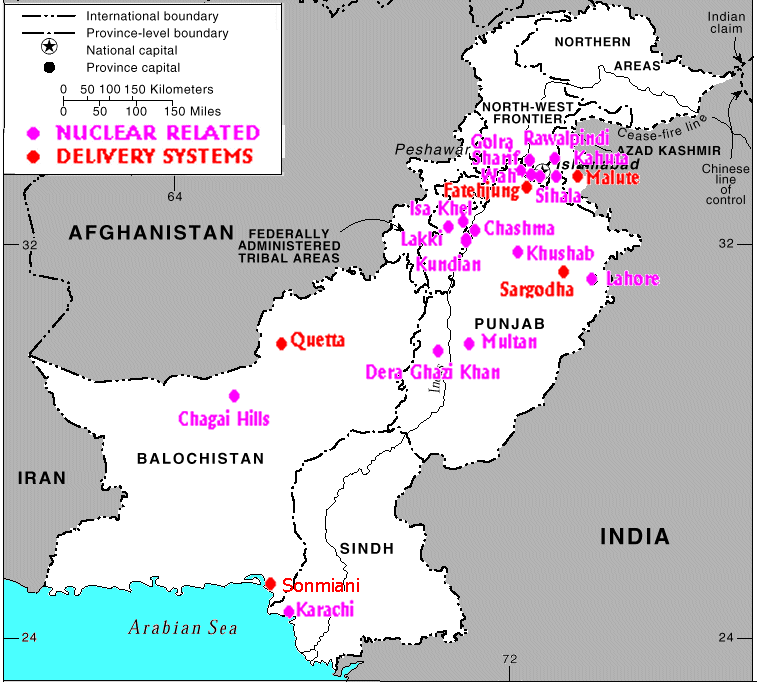
The attack highlights serious gaps in Pakistani security, and one has to wonder if the Pakistani nuclear facilities, which are spread throughout the country are under even greater threat than had been considered previously.

The Pakistanis had originally gotten three of the Orions, but one crashed a few years back. Now, the Pakistanis have one left for naval surveillance.

Friday, May 20, 2011

US Consulate Officials Attacked In Car Bombing In Pakistan

Pakistani Taliban terrorists carried out a car bombing against a US consulate convoy in Peshawar, Pakistan, apparently detonating 110 pounds of explosives in the process. Two officials were lightly injured and a Pakistani bystander was killed and 11 others wounded, as the attack was claimed by the Taliban to be in response to the US killing of Osama bin Laden.


It's the first such attack against US interests since bin Laden's death, and not surprisingly the Taliban are taking credit for the attack as revenge - not that the Taliban need an excuse to cause murder and mayhem.

Peshawar is home to many Afghan refugees, and the Taliban are frequently attacking Pakistani forces there as well:
“The attack was deliberately targeted against consulate vehicles,” he said.

“It was a bomb blast. We are still investigating.” The Pakistani Taliban swiftly claimed responsibility, in a telephone call to the AFP news agency, and threatened further attacks against Western targets.

"Our first enemy is Pakistan, then the United States and after that, other NATO countries,” said spokesman Ehsanullah Ehsan.

Police in the city said 11 people were hurt, including two foreigners who were slightly injured.

"A man on a motorbike who was passing by was killed in the blast, which was caused by a car bomb,” said one intelligence official on the scene.

The US maintains a small presence in Peshawar, despite a high security risk — heightened by America’s unilateral raid to kill the al-Qaeda leader.

The city is home to thousands of Afghan refugees and serves as a cross-border smuggling hub for insurgents.

On Wednesday, swarms of militants attacked a police checkpoint just outside the city. Two officers and 15 attackers died in a fire fight that lasted hours through the night.
It's not like the Taliban need excuses to murder people or cause mayhem. It's what they do.

Wednesday, May 11, 2011

Continuing Fallout From US bin Laden Raid; US Launched Raids Into Pakistan Prior to Successful Bin Laden Raid

While the successful mission to kill Osama bin Laden rightfully gets tons of press, it was hardly the first time that the elite DEVGRU/SEAL Team 6 operated within Pakistan with orders to go after high value targets. In fact, two such missions were carried out during the Bush Administration, but they came away without getting their targets. In one instance, the target was Ayman al Zawahiri.
But what it reveals is that last Monday's operation, which has sparked ferocious debate in Pakistan over national sovereignty, is far from the first time that elite US forces have mounted military operations on the ground in the nuclear-armed nation.

Prime Minister Yousaf Raza Gilani was to address parliament last night to reiterate a message driven home last week by Pakistani military chiefs - that the country would not tolerate any further breaches of sovereignty by the US or any other nation.

He was also expected to announce a parliamentary inquiry into the intelligence services' failure to detect bin Laden, who lived for five years under their noses in the garrison town of Abbottabad.

Pakistani army chief General Ashfaq Parvez Kayani told senior Pakistani journalists last week that "certain red lines had been crossed" by the US military.

Several people present at that briefing have suggested the subtext of his message was that the US had crossed a line by carrying out an operation in an area where Pakistan's urban and increasingly anti-US population could bear witness to it.

The Navy SEAL operation in Bajaur Agency was first reported by The New York Times in 2008, which cited a former top CIA official as confirming the mission.

A former ISI station chief for Pakistan's Pashtun-dominated northwest and tribal areas from 2001 to 2003, Asad Munir, yesterday also confirmed the 2006 operation took place, and was different to the drone strike on a suspected Zawahiri compound in January of the same year that is said to have killed up to 25 civilians.

"They flew over in helicopters, people came out on ladders and searched the compound, found nothing, and flew back," Brigadier Munir told The Australian.

"It was known by the ISI, but not by the media, and never made it to the newspapers. It was a very low-profile operation, but I have no doubt that it occurred."

He said yet another operation occurred in 2008 just over the Afghan border in South Waziristan, in which three US special operations officers raided a madrassa suspected of being used as a base from which insurgents were firing on coalition forces.

Rustam Shah Mohmand, a former chief secretary of the northwest frontier province and Tribal Areas Commissioner, also confirmed the fact that last week's Navy SEALs raid was not the first on Pakistani soil.
What makes the bin Laden raid notable is that it was successful in getting the target - and it was as high profile a target as can be imagined. When the other raids didn't get their targets, the teams involved were able to slip away.

Moreover, it appears that the ISI and military were caught flat footed over the bin Laden raid, as compared to closer coordination in the prior raids. Considering how the ISI and military have their fingers in every aspect of the Pakistani economy and security apparatus, it's hard for some to believe that the ISI or military didn't know that bin Laden was living in Abbottabad. In many respects, the ISI and military operate in the same fashion as Iran's IRGC does - complete with its own economic support system outside that of the local economy.

The Pakistani leadership is clearly red-faced in public over the raid; and they are quick to lay blame on the US for carrying out the raid even though there are ongoing indications that a significant segment of the Pakistani public and military and ISI are predisposed to bin Laden's worldview and radicalization.

At the same time, there are now reports that the US and Pakistan had worked out a deal a decade ago that the US would go after bin Laden in Pakistan. It was a secret deal between Pervez Musharraf and President Bush. Pakistani forces would allow unilateral raids by the US to go after bin Laden or Zawahiri.
The United States repeatedly told Pakistan that Washington would send American forces into that country if it had evidence that Osama bin Laden was hiding there, according to current and former U.S. officials.

The message that the United States would not hesitate to send American operatives into Pakistan to get bin Laden was transmitted to top Pakistani officials on multiple occasions by the administrations of Presidents Barack Obama and George W. Bush, said a U.S. national security official who asked for anonymity when discussing sensitive information.

A former senior U.S. counter-terrorism official, also speaking on condition of anonymity, said there was an "understanding" between Washington and Islamabad that amounted to an acknowledgment by Pakistani authorities that the United States would take unilateral action on Pakistani soil if it had intelligence on the al Qaeda leader's whereabouts.


Of course, the news of the secret deal has gotten the usual suspects in Pakistan upset. Even Musharraf originally stated that the US was in the wrong for going after bin Laden in Pakistan last week. Did anyone in the current government know about the deal, even as they were quick to blame the US for invading and violating their sovereignty. The nationalists in the Pakistani government are quick to blame the US, even though bin Laden was living under the Pakistani noses for years without anyone seeming to know anything about it.

Now, it's possible that Musharraf didn't inform the current Pakistani government or that the US didn't reiterate that understanding, but I find that hard to believe. Instead, it's much more likely that the Pakistanis wanted to find fault with the US actions because it shows just how little the US trusts the Pakistani ISI and military to keep a secret - and the possibility that the ISI/military could have been tipping off key al Qaeda/Taliban to avoid being captured/killed in these raids.

The question of Pakistani sovereignty is an odd one when one further considers that the Pakistanis can barely control their own territory - the frontier provinces are autonomous and Pakistani military forces operate there at their own risk because of Taliban and al Qaeda threats.

Meanwhile, bin Laden's son, Omar, is busy comparing the US raid to kill his father to an assassination and that Osama was denied some form of due process.
“When Osama did not resist, why wasn’t he arrested? After being killed, why didn’t the family get to identify him? Why was he buried at sea when that is against their Islamic beliefs?”

The questions were posted by Jean Sasson, an American writer, on her blog on Tuesday. Sasson helped bin Laden’s son Omar bin Laden write the memoir, “Growing Up bin Laden.” He has publicly denounced his father’s terrorism, but is still seeking answers to the circumstances around his death.

Sasson provided a further statement to the New York Times from Omar bin Laden, that said, “We maintain that arbitrary killing is not a solution to political problems ... justice must be seen to be done.”
Cry me a river - bin Laden declared war on the US; he never gave any of his thousands of victims due process; and that he wasn't armed when the raid happened doesn't detract from the fact that he was a mass murderer who was essentially caught with his pants down (lacking weapons and inadequate security) when the SEAL team killed him.

Tuesday, May 10, 2011

Who Will Follow Bin Laden as Head of Al Qaeda?

While much of the speculation as to who will assume the role as top terrorist in al Qaeda has fallen on Ayman al Zawahiri, there appears to be rumblings over whether he is sufficiently charismatic enough to keep the group going and whether he can get along with other terrorists.

Other possibilities include Anwar al Awlaki, whose followers have carried out several high profile attempted attacks in recent years.

Yet, there's one figure who hasn't quite made the headlines in the US who may be in a position to take over al Qaeda. He's a former Pakistani commando known as Ilyas Kashmiri.
An elusive figure who often wears heavily tinted aviator glasses, Kashmiri remains at large and active in plotting new attacks against the West, U.S. officials say. It was Kashmiri who, according to U.S. officials, was the key figure behind a suspected plot for multiple attacks in European cities, patterned after the 2008 Mumbai terror strike, which led to a widely publicized State Department travel advisory in October.

While Ayman al-Zawahri remains the “presumed” successor to bin Laden, the longtime al-Qaida deputy is deeply unpopular in some circles and his elevation is by no means guaranteed, a senior U.S. official told reporters this weekend. If al-Zawahri doesn’t make it, Kashmiri may emerge as the dark horse in the ensuing power struggle, the official told NBC on Monday.

“His star has been on the rise for the last several years,” said the official. “He would have to be on the al-Qaida short list.”

Kashmiri was at one point a member of the Pakistani military, serving as a commando in a Special Services Group that was once tasked with training Afghan mujahedeen to fight the Soviets.

He was later reassigned to train Kashmiri fighters against the Indians, but broke from the Pakistani army and joined a terrorist group — called Harakat-ul Jihad-i-Islami, or HUJI (“Movement of Islamic Holy War”) — that has been closely aligned with al-Qaida.


So far, U.S. officials have remained tight-lipped on whether they have found evidence in bin Laden’s compound that shows direct contacts between the now deceased al-Qaida leader and Kashmiri. But hints of such links — and of Kashmiri’s interest in mass casualty terror plots — are contained in U.S. court documents.
While Kashmiri was originally trained and worked closely with the Pakistani military and security services, he turned on Pervez Musharaf's regime and even targeted him in assassination attempts. His cadre of terrorists have carried out attacks in Pakistan, India, Kashmir, and plotted against the West, including a plot against Jyllands Posten for their running cartoons depicting Mohammad.

He's known to use the frontier provinces of Pakistan as his base of operations.

The US labeled him a specially designated global terrorist in August 2010, which puts him in the same ranks as the ex-bin Laden and Zawahiri. The US has attempted to carry out UAV airstrikes against him in the past, and have come close on several occasions, particularly after capturing several of his top henchmen.

Depending on who to believe, one would think that al Qaeda had three spheres of operation - the strategic, military, and ideological - with bin Laden, Kashmiri, and Zawahiri running each, respectively. However, with bin Laden's death and the cache of intel gathered from his compound in Abbottabad, that thinking may have been sorely misguided. It would appear that bin Laden was in command and control over most operational and strategic thinking of the terror group, using couriers to shuttle information between him and his subordinates.

Kashmiri, being central to these discussions, therefore may be in a better position to assume the leadership role. He's got the military credibility among the Taliban and knows his way through the region better than others, including Zawahiri. He also benefits from knowing Pakistani tactics and probabilities - where and how the Pakistanis operate their security forces and military. That's invaluable in evading capture or being struck in Pakistani airstrikes.

Monday, May 09, 2011

Pakistan's Government Deals With Fallout From Bin Laden Raid

Around the world, people are trying to figure out exactly how Osama bin Laden was able to live and thrive in the shadow of Pakistan's military academy for years without anyone in the Pakistani government knowing. Many suggest that the government was either incompetent or complicit in bin Laden avoiding capture for all these years.

Statements from bin Laden's wife suggests complicity with at least some members of the Pakistani security services such that while the government at its highest levels may not have known that bin Laden was in their country, others who did were doing their best to keep the government in the dark about bin Laden's whereabouts.


The US raid has raised the ire among both Pakistani Islamists and nationalists - each of whom have taken exception with the US and the Pakistani government. The US acted as though the Pakistani government was penetrated and could not be trusted. That could be seen as lack of faith in the Pakistani government, or that it provides the Pakistani government an out - allowing the Prime Minister to claim that the US acted alone to avoid the appearance of collusion in going after bin Laden that could raise the ire of the Islamists.

Prime Minister Gilani rejects the claims of incompetence or collusion, but those are pretty much empty statements without more evidence to suggest otherwise.
Gilani acknowledges Pakistan's "intelligence failures" over the bin Laden case, but says all the world's intelligence agencies also failed in the inability to track down the terrorist leader.

Update at 9:47 a.m. ET: In an address to Pakistan, he rejected the "blame game" in attempts to point the finger at Pakistan's military and intelligence agency, known as ISI.

"Yes, there has been an intelligence failure," Gilani says. "It is not only ours, but all intelligence agencies of the world. The al Qaeda chief, along with other al Qaeda operatives, have managed to elude other intelligence agencies for a long time."

He says, in fact, that ISI was responsible for a tip that helped lead the CIA to bin Laden's hideout in a compound in Abbottabad, 35 miles from Islamabad.

"It is disingenuous for anyone to blame Pakistan or the state institutions of Pakistan, including the ISI and the armed forces, for being in cahoots with al Aqaeda," he says.

He concedes that the issue of how bin Laden could hide in plain site is a source of concern in Pakistan, but says an investigation has been ordered to get to the bottom of it.

"Let's not rush to judgment," he says. "Charges of incompetence or complicity are absurd. We emphatically reject such speculation."
The problem is that the CIA and US officials both state that Pakistani intel services were in the dark about bin Laden's whereabouts and that they didn't consult with the Pakistanis before the raid, lest they tip off bin Laden as to the impending raid. While the Prime Minister claims full confidence in the Pakistani military and ISI, the behind the scenes situation is likely to be full of recriminations and demands for answers in how the government could have been left in the dark about bin Laden's whereabouts for so long.

The Pakistani government has to walk a fine line between dealing the Islamists a blow and nationalists who might side with the Islamists over the hard feelings created by the US raid to take out bin Laden with the government apparently in the dark about the raid until after the raid was already underway.

So, why did bin Laden choose Abbottabad? Well, it was central to Pakistan with easy access to Islamabad and a quick getaway to the frontier provinces should bin Laden be tipped off. Building a walled compound wouldn't be out of character, and the area was a frequent destination of vacationers and Pakistanis from all over the country.

I suspect that the military academy was another reason that bin Laden chose the town; it could provide a source for recruiting future jihadis.

It also appears that the compound wasn't nearly as militarized as one could have expected; there weren't escape tunnels, hidden weapons caches, or other accoutrements that one could expect around a terror master like bin Laden. Perhaps he grew complacent in the fact that he was hiding in plain sight and that his security measures were sufficient to avoid detection by the Pakistanis or that he wasn't expecting the US to carry out a raid against his compound.

Don't expect other al Qaeda terror masters like Awlaki or Zawahiri to make that same mistake. Both are more likely to take additional security precautions in light of how the US carried out the raid in Pakistan.

Friday, May 06, 2011

More Details Emerge On Raid That Got Bin Laden; And One That Missed

Now that al Qaeda has itself admitted that yes, Osama bin Laden is dead, the deathers (aka those who don't believe President Obama when he says that bin Laden is dead) will relent and admit that bin Laden is indeed dead as President Obama says? Any takers on that? I'll even give odds.

No? Good. Because some people will never admit that bin Laden was killed in that raid.

In any event, bin Laden was quite busy while lounging in that Abbottabad compound all these years (his wife says she never left in all that time) plotting and planning further attacks. That he was focusing on railways around the world, and particularly in the US is quite troublesome because rail security particularly in the US has always lagged that of the airlines.

The US has also carried out the first UAV airstrike since bin Laden's death, targeting terrorists in the frontier province of Waziristan:
A suspected CIA drone strike targeted a hotel Thursday in the North Waziristan region of Pakistan’s borderlands, killing eight people, according to Pakistani news reports.

A series of missiles pounded the town of Datta Khel, near what U.S. officials believe is the headquarters of the Haqqani network, an Afghan insurgent force that has staged deadly bombings in Afghan cities and regularly attacks NATO troops in eastern Afghanistan.
Meanwhile, as details continue to leak about the raid that killed bin Laden, we're learning about the efforts that came up short to get bin Laden in the past.

The NYT reports that intel had indicated that bin Laden may have contemplated a meeting in Tora Bora in 2007, and that a mission was planned and aircraft routed to intercept, but were called back when the intel turned out to be less than reliable and concerns raised about collateral damage. That instead led to a commando mission - killing a bunch of terrorists, but revealing that bin Laden wasn't among them.
“We thought we had ‘No. 1’ on this side of the border,” said a senior American military officer involved in planning the operation. “It was the best intelligence we’d had on him in a long time.”

The military set into motion one of the largest strike missions of its kind, with long-range bombers, attack helicopters, artillery and commandos all ready to pummel the rugged mountain valley along Afghanistan’s border with Pakistan, according to military officers and former government officials.

But just as the half dozen B-2 Stealth bombers were halfway on the 3,000-mile flight to their target, commanders ordered them to return to their secret base in the Indian Ocean, because of doubts about the intelligence on Bin Laden and concerns about civilian casualties from the bombs.

A smaller, more precise raid was carried out by commandos and attack helicopters, killing several dozen militants in the episode, which has not been previously disclosed.

But the founder and formative figure of Al Qaeda was not there.

Inside the White House, the disappointment was palpable, according to senior aides to former President George W. Bush. What might have been Mr. Bush’s last chance at redeeming his administration’s failure to capture or kill Bin Laden after the 2001 invasion of Afghanistan, when he was cornered in the same Tora Bora region but escaped into Pakistan, did not materialize.

Amid the national relief over the killing of Bin Laden by a Navy Seal team in Abbottabad, Pakistan, this secret chapter in the hunt for the world’s most famous fugitive is a reminder of the years of frustration and false hopes government officials endured in trying to pick up his trail.
Note too that this was after the shutdown of the bin Laden section in the CIA by the Bush Administration.

It also shows that the CIA was still not on the ball when it came to bin Laden and al Qaeda's operational hierarchy. After all, the CIA was stating at that time that:
The decision is a milestone for the agency, which formed the unit before Osama bin Laden became a household name and bolstered its ranks after the Sept. 11 attacks, when President Bush pledged to bring Mr. bin Laden to justice "dead or alive."

The realignment reflects a view that Al Qaeda is no longer as hierarchical as it once was, intelligence officials said, and a growing concern about Qaeda-inspired groups that have begun carrying out attacks independent of Mr. bin Laden and his top deputy, Ayman al-Zawahiri.

Agency officials said that tracking Mr. bin Laden and his deputies remained a high priority, and that the decision to disband the unit was not a sign that the effort had slackened. Instead, the officials said, it reflects a belief that the agency can better deal with high-level threats by focusing on regional trends rather than on specific organizations or individuals.
The US focus had shifted towards going after al Qaeda's mid level terror network, perhaps hoping to lead to the high value targets in the process. That too may have led them to carry out the 2007 attack in the hopes of capturing or killing bin Laden.

UPDATE:
The Pakistanis can cooperate only so much without setting off the Islamists in a serious way. One report today indicated that the Pakistanis knew to some extent about the raid and have to claim otherwise to keep the Islamists from jumping ugly in a serious way to overthrow the government.

Another report indicates that the US informed the Pakistanis that they were carrying out this mission - while the mission was already underway. Details may or may not be accurate that the Pakistanis had scrambled jets to deal with the inbound flight of US helicopters and were sent away once notification reached the Pakistani military. The lede on that report was that the US could have been close to having a disastrous run-in with the Pakistani military during the mission inside Pakistan's borders with disastrous consequences for both sides.

If the Pakistanis are now scrambling to make more arrests, that intel could come one of four different paths: (1) directly from the people who the US left behind at Abbottabad, (2) the US could have sent them the necessary intel; (3) gathered from independent sources completely; (4) combination of sources. No way to know for sure.

It's the same deal about today's UAV airstrike - there's no way to know if it is connected with the OBL mission raid intel cache, or whether it was planned separately.

UPDATE:
It appears that the CIA was tracking the Abbottabad compound from a house nearby. They used a variety of electronic eavesdropping methods, but the agency refuses to comment on those reports. Some means and methods should not be revealed, lest they reveal too much about tactics and capabilities that the US uses to track down al Qaeda and other high value targets around the world.

UPDATE:
Further evidence of Pakistani duplicity - based on statements being released from the Pakistanis themselves. It raises still more troubling details in the bin Laden search over the years - particularly in how the Pakistanis were involved, especially as it relates to bin Laden's wife who is now in Pakistani custody.
A few key points from the story: She’s now in Pakistani custody, recovering from the gunshot wound; U.S. intelligence officials are unlikely to get the chance to speak with her. After 9/11 when the Afghan campaign began, Pakistan’s government reportedly gave her haven and helped her return to Yemen. She later reentered Pakistan to join her husband, which, as McGirk writes, points out a potentially major intelligence lapse in hindsight: Why take years deciphering courier aliases when bin Laden’s wife could have led them right to him?

On top of that, there’s this detail of further alleged Pakistani duplicity, which will only further inflame tensions at a delicate moment:

Says [an] Arab woman formerly connected to al-Qaeda: “There was an understanding with the Pakistani army. We would get a tip-off that the army planned to raid one of our houses in the tribal area. We would flee but leave some ‘evidence’ behind so that the army could show to the Americans that we’d been there.”
I have no doubt that the latter may help explain the former. If the CIA believed that the Pakistanis were laying down a false trail or were coopted by al Qaeda, then trying to track down bin Laden based on his wife's whereabouts could have been seen as a false trail. This reinforces the notion that the Pakistanis were apparently left in the dark about the operation because the US didn't trust elements within the Pakistani government to not tip off al Qaeda and bin Laden. It also explains, in part, why the Pakistanis aren't going to let the CIA and US officials anywhere near her. On top of cultural and religious misgivings over such interrogations, bin Laden's wife would likely reveal much about bin Laden and al Qaeda's relationship with those within the security services and military.

UPDATE:
Apparently the Pakistanis understand the visuals of the situation, and they may have decided that the best course of action is to sack the head of the Pakistani intel services (ISI):
To allay both domestic and international anger and dismay over the presence of Osama bin Laden in a military cantonment town close to the capital, senior Pakistani officials have told The Daily Beast they recognize that an important head has to roll and soon. They say the most likely candidate to be the fall guy is Lt. Gen. Ahmad Shuja Pasha, the director general of the country’s spy agency, the Inter-Services Intelligence directorate. In a last ditch effort to control the damage and to assure the US that the ISI was not harboring him and was unaware of his presence in Pakistan, Pasha reportedly flew to Washington today. But these high-level sources who refused to be quoted or named say his resignation is only a matter of time.

Wednesday, May 04, 2011

More Details Emerge on Raid That Killed Bin Laden

More details continue to emerge about the raid that killed Osama bin Laden and the kind of information obtained. Apparently bin Laden had cash and phone numbers sewn into his clothes in order to be able to make a quick getaway should he be cornered.
Osama bin Laden had 500 Euros in cash and two telephone numbers sewn into his clothing when he was killed, CBS News has confirmed.

The news was first reported by Politico Wednesday. It was unclear whether the money was denominated in Euros or another currency, but the revelation seems to indicate that the al Qaeda leader was prepared to flee in the event of a raid like the U.S. military strike in which he was killed on Sunday.

The Killing of Osama bin Laden

The details come from officials who attended a classified intelligence briefing on Capitol Hill.

"CIA Director Leon Panetta told lawmakers about the items found in bin Laden's clothing in response to a question about why he wasn't guarded by more security personnel at his relatively luxurious home in a military town north of Islamabad," Politico reported. "The answer, according to one source who attended the briefing: Bin Laden believed "his network was strong enough he'd get a heads-up" before any U.S. strike against him."
You can be sure that the US is going to track down those phone numbers although al Qaeda has likely disposed of those phones. Those numbers will still be extremely useful in clawing back through bin Laden's movements and confirming other intel gathered over the past several years.

The cache of documents, computer files, and other information will yield much about al Qaeda's ongoing operations, financial dealings, and potential terror operations that were being considered or green lighted.

UPDATE:
Pakistani sources are attempting to give a different version of events, including intimating that the US special forces essentially executed bin Laden, which runs counter to the official US line. One has to take the Pakistani reports with more than a grain of salt as they frequently publish rumors and conspiracies as fact. Still, the official US version of events has shifted in the past several days as new details emerge.

UPDATE:
Who owned the compound where bin Laden was killed, and what does it say about those who surrounded bin Laden all these years?
The Pakistani who owned the compound that sheltered Osama bin Laden in his final years said he was buying the property for “an uncle,” according to the doctor who sold the land in 2005.

The man was identified in property records as Mohammad Arshad; neighbors said one of two Pakistani men living in the house went by the name Arshad Khan. The two names apparently refer to the same man and both names may be fake. But one thing is clear — bin Laden relied on a small, trusted inner circle as lifelines to the outside who provided for his daily needs such as food and medicine and kept his location secret. And it appears they did not betray him.

Among those in that inner circle were Arshad and his brother. Arshad is suspected as the courier who ultimately led the Americans to bin Laden, unwittingly, after years of painstaking tracking. American officials said the courier and his brother were killed in the American commando raid Monday in the northwestern Pakistani town of Abbottabad.

The true identities of the two confidants and their exact links to other high ranking al-Qaida figures remain one of the biggest mysteries surrounding bin Laden. But more details about one of the key aides to bin Laden emerged Wednesday.

Qazi Mahfooz Ul Haq, a doctor, told The Associated Press on Wednesday that he sold a plot of land to Arshad in 2005. He said the buyer was a sturdily built man who had a tuft of hair under his lower lip. He spoke with an accent that sounded like it was from Waziristan, a tribal region close to Afghanistan that is home to many al-Qaida operatives.

Tuesday, May 03, 2011

Fallout from Bin Laden's Death and What Did Pakistan Know?

Fallout from the death of Osama bin Laden continues to ripple throughout the world. Bin Laden's burial at sea has been criticized, even though that's a far better fate than the nearly 3,000 who were murdered at the World Trade Center. Some criticize that the US was too respectful, while others claim the US was not respectful enough. To me, that says that the US got it right - and I believe that the burial at sea was necessary to eliminate any possibility that his burial site could be treated as a rallying point.

As new details of the raid continue to leak out, the real questions are being pointed in the direction of Pakistan. What did they know and when did they know that bin Laden was living large in their country?

Pakistani President Asif Ali Zardari submitted an op-ed in the Washington Post today in response to the US mission that killed Osama bin Laden in the town of Abbotabad, just miles from the Pakistani capital of Islamabad.
Let us be frank. Pakistan has paid an enormous price for its stand against terrorism. More of our soldiers have died than all of NATO’s casualties combined. Two thousand police officers, as many as 30,000 innocent civilians and a generation of social progress for our people have been lost. And for me, justice against bin Laden was not just political; it was also personal, as the terrorists murdered our greatest leader, the mother of my children. Twice he tried to assassinate my wife. In 1989 he poured $50 million into a no-confidence vote to topple her first government. She said that she was bin Laden’s worst nightmare — a democratically elected, progressive, moderate, pluralistic female leader. She was right, and she paid for it with her life.

Some in the U.S. press have suggested that Pakistan lacked vitality in its pursuit of terrorism, or worse yet that we were disingenuous and actually protected the terrorists we claimed to be pursuing. Such baseless speculation may make exciting cable news, but it doesn’t reflect fact. Pakistan had as much reason to despise al-Qaeda as any nation. The war on terrorism is as much Pakistan’s war as as it is America’s. And though it may have started with bin Laden, the forces of modernity and moderation remain under serious threat.

My government endorses the words of President Obama and appreciates the credit he gave us Sunday night for the successful operation in Khyber Pakhtunkhawa. We also applaud and endorse the words of Secretary of State Hillary Clinton that we must “press forward, bolstering our partnerships, strengthening our networks, investing in a positive vision of peace and progress, and relentlessly pursuing the murderers who target innocent people.” We have not yet won this war, but we now clearly can see the beginning of the end, and the kind of South and Central Asia that lies in our future.

Only hours after bin Laden’s death, the Taliban reacted by blaming the government of Pakistan and calling for retribution against its leaders, and specifically against me as the nation’s president. We will not be intimidated. Pakistan has never been and never will be the hotbed of fanaticism that is often described by the media.
Zardari is in a real tough position right now. He's got to simultaneously defend his country from claims that he was harboring al Qaeda's top dog, claiming that he was providing assistance (unidentified and uncorroborated by US officials who have studiously stated that they shared no aspects of this mission with any other country, including Pakistan), and has to be worried that the Islamists will try to topple his government because of its existing ties with the US (a belief that the government is complicit with the US even if there was no actual). Given the way that Pakistanis love their conspiracy theories (even more than the nutjobs who think Osama wasn't real, wasn't killed, or any permutation thereof), all kinds of speculation is rampant in Pakistan right now over what Pakistan's government knew and when did they know of it.

Fact is, no one really knows what the Pakistani government knew about bin Laden's location, but it is highly suspicious that he was able to live in relative comfort in a compound just yards from the country's military academy and where military personnel go to retire. It is plausible that members of the military or the ISI were complicit in keeping bin Laden's whereabouts hidden but it once again indicates the difficulty of trusting the Pakistani government to reveal key details. Those questions are being asked by members of Congress on both sides of the aisle - and they have good reason to ask those questions. Similar questions are being asked by other countries, including the UK.

Zardari is right to state that his country has been ravaged by Islamic terrorists, particularly Taliban and al Qaeda. Yet, each time the Pakistani government (whether under Zardari or his predecessor, Pervez Musharraf) cracks down, it doesn't go far enough to eliminate the threat. It does just enough - anything more and the Islamists in the Pakistani government (Parliament, military, ISI) would thwart further action.

He further claims that radical Islamist parties make up a small fraction of his government, but that overlooks those other groups that lean towards radicalism and who do not condone crackdowns against the Islamists.

Pakistan barely maintains control over the frontier provinces, which are overrun with Taliban and have hosted al Qaeda for years on end. Efforts to thwart the Taliban have met with mixed success - and the body count among Pakistani soldiers is quite high and

The country can't align itself too greatly with the US for fear of assassinations or coups to install a more Islamist government, but doing nothing allows the Islamists free reign in the frontier provinces.

The question of what Pakistan knew and who knew might be revealed in the treasure trove of intel captured by the special forces team that carried out the mission. They recovered numerous computers, hard drives, thumb drives, and other intel that can be critical to unraveling the logistical network and other contacts, as well as identifying other key members and locations. It could also shed light on other planned or contemplated targets.

Bin Laden's death may also result in a reappraisal of ongoing military operations by the ISAF in Afghanistan, including the possible withdrawal of troops earlier than 2014. I think that would be a serious mistake, considering that al Qaeda and the Taliban remain a serious threat, and allowing them safe haven is a mistake.

Monday, April 04, 2011

Failed Pakistani Suicide Bomber Hopes To Try Again

A teenage Pakistani suicide bomber whose bomb failed to detonate hopes to have the opportunity to try again. He and his cohorts had planned to blow up parishioners at a Sufi shrine and while the teenager's bomb didn't detonate, several others did - killing 42 people and wounding 100 more:
A teenage suicide bomber who failed to blow up pilgrims at a shrine in Pakistan stunned his captors when he made clear how desperate he was to die for his cause.

"Let me go, I want to be a martyr," 14-year-old Fida Hussain screamed as policemen led him away. "I want to send all you policemen to hell."

While Hussain was unable to detonate the bomb strapped to his chest, others succeeded Sunday, killing 42 people and wounding 100 more among the thousands gathered at a Sufi shrine near Dera Ghazi Khan.

A second suspect was also detained alive at the shrine, but police revealed no details about him.

Both apparently hail from an area known for breeding militants.

With his strikingly boyish face, Hussain represents the most insidious practice of the Taliban in recruiting young, uneducated boys to carry out suicide attacks.

Experts say young boys are not only less suspicious, but they are easier to indoctrinate into the cause.

"You are all accomplices of the enemies of Islam who are bent upon eliminating Islam and Muslims," Hussain yelled, according to police officer Khalid Mahmood.
The Taliban and al Qaeda recruit from those who are wholly ignorant and are impressionable in order to indoctrinate them into a nihilistic worldview where those who do not practice Islam as they do are worthy targets and that promises of paradise in the afterlife are sufficient to lure them into becoming suicide bombers.

This is the face of evil in Pakistan, and the Islamists in Pakistan have created a monster in which they backed the Taliban and protect those who are enabling these extremists to indoctrinate many more to their cause. Anyone who speaks out against laws like the anti-blasphemy laws, is targeted for assassination. Non-Muslims are targets, and anything that can be used to whip their fellow Islamists into a violent frenzy is seized upon, including the idiot Florida Pastor Terry Jones, whose exhortations to burn a koran and hold a mock trial of Mohammad has led to multiple days worth of rioting and more than a dozen dead.

Friday, March 04, 2011

Pakistani Christians Bury Assassinated Government Minister Who Supported Repeal of Anti Blasphemy Laws

Shahbaz Bhatti was laid to rest in his home village in Pakistan after being assassinated on Wednesday because he sought a repeal of the country's notorious anti-blasphemy laws.
Thousands of Pakistani mourners have attended the funeral of murdered minorities minister Shahbaz Bhatti.

Mr Bhatti, a Christian, was shot dead on Wednesday by the Taliban after he urged reform to blasphemy laws.

There were emotional scenes as several thousand Christians buried their leader in his home village near Faisalabad.

Earlier, hundreds turned out for a church service in the capital. Prime Minister Yousuf Raza Gilani told them his colleague had been "very rare".

Wednesday's assassination in Islamabad was the second this year of a Pakistani politician who wanted to reform the controversial blasphemy laws.
The ease with which Bhatti was assassinated led to calls for the resignation of key security ministers and investigations.

The blasphemy law imposes a death sentence for anyone who insults Prophet Muhammad or the religion of Islam, but its opponents note that the law has been used to settle personal scores and persecute members of the minority faiths.

Gilani was among those paying their respects at the funeral, but President Zardari did not attend, and the ruling party has refused to reform the blasphemy law.
Bhatti and Punjab province Gov. Salman Taseer both criticized the blasphemy laws after a Christian woman was sentenced to death under them last year. On Jan. 4, Taseer was shot dead by one of his bodyguards, who said he was angry about the governor's stance on the laws.

But the ruling party abandoned Bhatti and Taseer on the subject, a sign of how scared they are of upsetting powerful Islamist groups. Gilani has repeatedly insisted the government would not change the laws.

President Asif Ali Zardari did not attend the funeral mass or the burial service in Khushpur, though he rarely makes public appearances out of fear for his life. Also notably missing were top leaders of the main opposition party, the Pakistan Muslim League-N, which is considered somewhat sympathetic to Islamists.

There are reports that Gilani offered to step down because of the assassination because someone had to take responsibility for the security lapses.

What's needed is that Pakistan's top leadership repudiate the blasphemy laws and reform the law. Instead, they're cowed by the threats of violence against those who express any views that are antithetical to the Islamic extremists.