It's been 25 years since the worst nuclear disaster in history occurred at Chernobyl's Reactor 4 in the Ukraine took the lives of more than 40 who worked at the plant and emergency responders and affected the lives of millions living downwind and in the zone of exclusion set up around the stricken plant.
The explosion, caused by human error combined with poor design, killed several workers instantly. The RBMK reactor design had a fatal flaw when operating at low power, and when workers were conducting a test, they entered that low power state without necessary backups in place and output spikes became uncontrollable and ultimately led to the destructive explosion of the core. Without the kind of containment in place for reactors common around the rest of the world, the core ruptured the reactor building and exposed the surrounding region to heavy doses of radiation and radioactive debris was flung into the air.
It further killed several dozen of the firefighters and liquidators who came in to put out the fire and to seal up the exposed reactor with a concrete sarcophagus:
The health consequences for those liquidators is still up in the air, and health experts debate just how many more deaths can be linked to the disaster in the affected population downwind of the reactor.
Efforts to build a new containment structure have been hamstrung by a lack of funds, and the most recent effort came up nearly $200 short for the expected $1 billion project.
Ultimately, the disaster may have helped spark the breakup of the Soviet Union and exposed just how bad the country's infrastructure and technological prowess truly was.
Showing posts with label Chernobyl. Show all posts
Showing posts with label Chernobyl. Show all posts
Tuesday, April 26, 2011
Tuesday, April 19, 2011
Ukraine Falls Short In Fundraising Effort To Build New Containment System for Chernobyl
The existing containment sarcophagus that surrounded the badly damaged Chernobyl reactor needs to be replaced and the proposed new containment structure is likely to cost more than $1 billion and foreign donors are needed to get this critical structure built.
Despite the critical need, the effort came up short. Only $790 million was raised. With the world's attention focused on the ongoing Japanese nuclear emergency at Fukushima and the crises compared to each other, it's worth remembering just how deadly and dangerous Chernobyl was and that a containment structure is critical to managing future risk from radioactive contamination.
The original Chernobyl sarcophagus was built hastily and water leaks in, posing an ongoing threat to the water table. Equipment is in place to collect and treat the radioactive water, but earthquakes can cause further damage and highly radioactive materials within the sarcophagus could shift or collapse, causing further releases of radioactive particles into the environment. The new containment structure would not only protect the existing sarcophagus, but allow crews the ability to better stabilize and fortify the structures.
Despite the critical need, the effort came up short. Only $790 million was raised. With the world's attention focused on the ongoing Japanese nuclear emergency at Fukushima and the crises compared to each other, it's worth remembering just how deadly and dangerous Chernobyl was and that a containment structure is critical to managing future risk from radioactive contamination.
The original Chernobyl sarcophagus was built hastily and water leaks in, posing an ongoing threat to the water table. Equipment is in place to collect and treat the radioactive water, but earthquakes can cause further damage and highly radioactive materials within the sarcophagus could shift or collapse, causing further releases of radioactive particles into the environment. The new containment structure would not only protect the existing sarcophagus, but allow crews the ability to better stabilize and fortify the structures.

Wednesday, January 31, 2007
Reluctant Spokesman
It took a grieving 21-year-old, mourning the loss of his World Trade Center cop father, to finally shame President Bush yesterday into helping other forgotten heroes of 9/11.I give the New York lawmakers, including Senator Hillary Clinton credit for keeping this issue a priority. I've been following the issue for some time now, and I feared that the government would treat the Ground Zero workers no better than the former Soviet Union treated the liquidators who gave their all to quell the radioactive fires at Chernobyl in 1986.
The White House ended years of foot-dragging by budgeting $25 million to help ailing Ground Zero workers, making the announcement just before Bush is to meet today with Ceasar Borja Jr., the son of a cop who died after breathing the toxic air there for months.
"I want the President to know that he has to take care of these people, because many more will die," Borja told the Daily News yesterday in his Bayside, Queens, home, moments after getting the news. "Any sum of money is a help, and I just hope that it continues."
New York's lawmakers have relentlessly pounded Bush to fund World Trade Center-related illness for years.
Borja is a reluctant spokesman. He didn't want to be in this position, but his father's sacrifice, subsequent illness and death was a life changing event that thrust him into the spotlight and now has the bully pulpit to demand more aid to other workers affected by their service at Ground Zero.
That said, the Bush bashing isn't entirely well placed. Congress is responsible for appropriations, and they have not done a sufficient job in setting aside aid. New York City and New York State have similarly passed the buck on the aid (hoping someone else will pick up the tab), and the insurance fund set up to assist those affected by Ground Zero illnesses has been obstinate in disbursing funds, even five years later.
The $25 million set aside is a good start. It is going to be the tip of a very large iceberg as thousands of other workers at the site may yet come down with ailments relating to their service at Ground Zero. There is also the question of ailments by those downwind of Ground Zero, both in Battery City and across the bay in Brooklyn Heights/Cobble Hill. As the Daily News points out:
"We fully expect to be out of funds by the end of this summer," said Dr. Jacqueline Moline of Mount Sinai Medical Center's World Trade Center health program. "There are 34,000 patients that are supposed to be treated with the $25 million, and that's not going to go very far."The list of those killed as a result of 9/11 will continue to grow as more succumb to ailments relating to their service at Ground Zero following the attacks.
Health experts estimate the hospital needs $250 million a year to treat sick workers, and Sen. Hillary Clinton (D-N.Y.) has called for $1.9 billion in funding over several years.
Wednesday, September 06, 2006
The New Liquidators
Are we witnessing another uncomfortable repeat of history? It certainly seems that there are some striking parallels between the way the US government is handling the health of those workers who answered the call to clear Ground Zero and those who did the same at Chernobyl 20 years ago. April 28, 1986 marked the date that Chernobyl's nuclear power plant number 4 exploded, releasing clouds of radioactive materials into the atmosphere and causing extensive damage the area. The first firefighters arriving on the scene had no idea what they were up against, and they quickly succumbed to massive doses of radiation poisoning. The Soviet government quickly marshaled together a huge force of soldiers and conscripts to undertake the
massive task of extinguishing the fires and creating a containment facility for the devastated reactor building. It took more than a week to extinguish the fires.
Those people who sought to contain the fires and radiation came to be known as liquidators. Many had no idea what they were dealing with and soldiered on to complete the task of enclosing the destroyed nuclear reactor in a concrete sarcophagus that would hopefully contain the nuclear materials still present at the
site. The soldiers swarmed the nearby countryside trying to gather together nuclear materials so that they can be disposed of.
The concrete sarcophagus was built and the immediate danger of further radioactive releases from the destroyed reactor was contained. The liquidators went on with their lives although some unknown number came down with illnesses that could be linked back to their time cleaning up the Chernobyl site. No one quite knows the numbers who succumbed from Chernobyl because the Soviets desperately sought to hide the truth not only from the West, but from their own people. There are no accurate numbers of those killed or injured from Chernobyl - the numbers range from under 100 to the tens of thousands.
Meanwhile, a world away and nearly two decades later, on September 11, 2001, Islamic terrorists destroyed the World Trade Center and damaged more than a dozen other buildings in Lower Manhattan. Millions of square feet of office space was in ruins or contaminated by debris from the collapsed towers. A huge rescue and recovery effort was mounted by emergency personnel and construction workers. Fires burned at the site for months, with smoke, gases, and particulates pouring from the pile. All through this time, those workers worked around the clock to find remains so that loved ones could gain some semblance of closure and clear the site.
Those people worked on the Pile for months at end until the nearly 2 million tons of rubble, remains, and debris was cleared from the site.
Throughout that time, the workers were assured that the air was within safety limits and that as long as they used respirators and other safety equipment they would not suffer any ill effects.
We now know that the EPA should not have made definitive statements assuring workers that the air was safe to breathe. It was not. The air was contaminated with all sorts of materials, including volatile organic compounds, pulverized concrete, and
asbestos. Respirators and other safety masks were either eschewed or their utility limited in dealing with all the contaminants.
So it is worrisome that we now hear about cases of those working on the Pile suffering the ill-effects from their endeavors. Some have become permanently disabled due to respiratory ailments, and in one instance, a New Jersey medical examiner ruled that police officer James Zadroga died as a result of working at the Pile. Zadroga spent 470 hours working on the Pile.
Some have made excuses their illnesses noting the difficult job of tracing the source of a variety of ailments to exposure at Ground Zero. City, state and
federal law make it incredibly difficult for some to obtain needed health care or disability payments because the statute of limitations comes into play. The City Health Department is currently tracking 70,000 people to see whether they are suffering ill effects from exposure to Ground Zero contaminants. A study at Mount Sinai Medical Center has found that 70% of those working at Ground Zero have suffered some form of respiratory ailment as a result of working at Ground Zero. That could be anything from respiratory failure to nagging coughs or other issues. 61% of those who now suffer from these ailments were not sick prior to their service at Ground Zero.
most importantly, ensuring that they have access to medical care and treatment for Ground Zero related ailments should be the absolute minimum. This shouldn't be about cost. It should be about honoring those who did the hard work of clearing the site of
the worst terrorist attack on US soil and remembering that those attacks are still claiming victims.
The City has announced a plan to deal with the health crisis, and includes guidelines for identifying ailments relating to work at Ground Zero. That's an important step, as is further study to determine not only what is causing the ailments facing these people, but finding treatments and cures to these potentially fatal conditions.
Technorati: World Trade Center, WTC, pataki, LMDC, mount sinai, respiratory ailment, wtc cough, bloomberg.
massive task of extinguishing the fires and creating a containment facility for the devastated reactor building. It took more than a week to extinguish the fires.
Those people who sought to contain the fires and radiation came to be known as liquidators. Many had no idea what they were dealing with and soldiered on to complete the task of enclosing the destroyed nuclear reactor in a concrete sarcophagus that would hopefully contain the nuclear materials still present at the
site. The soldiers swarmed the nearby countryside trying to gather together nuclear materials so that they can be disposed of.
The concrete sarcophagus was built and the immediate danger of further radioactive releases from the destroyed reactor was contained. The liquidators went on with their lives although some unknown number came down with illnesses that could be linked back to their time cleaning up the Chernobyl site. No one quite knows the numbers who succumbed from Chernobyl because the Soviets desperately sought to hide the truth not only from the West, but from their own people. There are no accurate numbers of those killed or injured from Chernobyl - the numbers range from under 100 to the tens of thousands.
Meanwhile, a world away and nearly two decades later, on September 11, 2001, Islamic terrorists destroyed the World Trade Center and damaged more than a dozen other buildings in Lower Manhattan. Millions of square feet of office space was in ruins or contaminated by debris from the collapsed towers. A huge rescue and recovery effort was mounted by emergency personnel and construction workers. Fires burned at the site for months, with smoke, gases, and particulates pouring from the pile. All through this time, those workers worked around the clock to find remains so that loved ones could gain some semblance of closure and clear the site.
Those people worked on the Pile for months at end until the nearly 2 million tons of rubble, remains, and debris was cleared from the site.
Throughout that time, the workers were assured that the air was within safety limits and that as long as they used respirators and other safety equipment they would not suffer any ill effects.
We now know that the EPA should not have made definitive statements assuring workers that the air was safe to breathe. It was not. The air was contaminated with all sorts of materials, including volatile organic compounds, pulverized concrete, and
asbestos. Respirators and other safety masks were either eschewed or their utility limited in dealing with all the contaminants.
So it is worrisome that we now hear about cases of those working on the Pile suffering the ill-effects from their endeavors. Some have become permanently disabled due to respiratory ailments, and in one instance, a New Jersey medical examiner ruled that police officer James Zadroga died as a result of working at the Pile. Zadroga spent 470 hours working on the Pile.
Some have made excuses their illnesses noting the difficult job of tracing the source of a variety of ailments to exposure at Ground Zero. City, state and
federal law make it incredibly difficult for some to obtain needed health care or disability payments because the statute of limitations comes into play. The City Health Department is currently tracking 70,000 people to see whether they are suffering ill effects from exposure to Ground Zero contaminants. A study at Mount Sinai Medical Center has found that 70% of those working at Ground Zero have suffered some form of respiratory ailment as a result of working at Ground Zero. That could be anything from respiratory failure to nagging coughs or other issues. 61% of those who now suffer from these ailments were not sick prior to their service at Ground Zero.
Mount Sinai Medical Center doctors - who said the study provides conclusive proof that the WTC site caused illnesses - also found 61 percent of first responders and cleanup workers had no health problems before 9/11 and became ill after working downtown.The men and women who worked on the Pile and completed this task deserve to be treated better than the liquidators who cleaned up Chernobyl. They should get honest and unvarnished information from all levels of the government about the air conditions at the site. There should be recognition that some of those at the site eschewed the use of the respirators and other safety equipment and that this may have contributed to the declining health conditions of some workers. And
Another 9 percent had pre-existing health ailments - such as asthma - but became sicker from working at or near the collapsed trade centers.
One-third had "abnormal" lung capacity - more than double the national rate. And the number of workers who came down with pneumonia also increased significantly, the report said.
most importantly, ensuring that they have access to medical care and treatment for Ground Zero related ailments should be the absolute minimum. This shouldn't be about cost. It should be about honoring those who did the hard work of clearing the site of
the worst terrorist attack on US soil and remembering that those attacks are still claiming victims.
The City has announced a plan to deal with the health crisis, and includes guidelines for identifying ailments relating to work at Ground Zero. That's an important step, as is further study to determine not only what is causing the ailments facing these people, but finding treatments and cures to these potentially fatal conditions.
Technorati: World Trade Center, WTC, pataki, LMDC, mount sinai, respiratory ailment, wtc cough, bloomberg.
Wednesday, April 26, 2006
Chernobyl: 20 Years Later
April 26, 1986.
Reactor Number Four at the Chernobyl nuclear power station in Pripyat, Ukraine suffered a major failure and the ensuing explosion released highly radioactive materials into the atmosphere. If that wasn't bad enough, the Soviet Union didn't inform foreign countries, let alone its own citizens for several days until a Sweedish nuclear facility recorded high levels of radioactivity and began to sound the alarm of a serious incident somewhere. We later came to know that it was a major failure at Chernobyl's reactor complex. An entire nuclear reactor failed and without any secured containment dome, vast amounts of highly radioactive material were thrown into the air and onto the surrounding countryside. And the Soviets refused to acknowledge the failure or evacuate people from surrounding communities for days.
In the end, the Soviets did eventually snuff out the radioactive fires, built a containment structure (which itself needs to be encased in a new structure because it is failing as well), and evacuated hundreds of square miles of the Ukrainian countryside. Ukraine is holding a week long commemoration of the disaster. The health effects are still being debated to this day.
UPDATE:
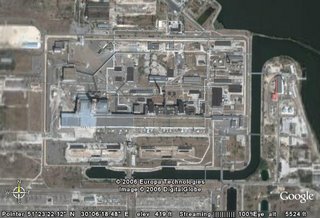
Here's a satellite map of the current Chernobyl nuclear power station. The damaged reactor is entombed under the light gray structure (center-left) - the sarcophagus - which itself needs to be repaired/replaced due to ongoing radioactive decay and structural problems.
Technorati: chernobyl, nuclear accident, radiation, soviet union, ukraine, pripyat.
Reactor Number Four at the Chernobyl nuclear power station in Pripyat, Ukraine suffered a major failure and the ensuing explosion released highly radioactive materials into the atmosphere. If that wasn't bad enough, the Soviet Union didn't inform foreign countries, let alone its own citizens for several days until a Sweedish nuclear facility recorded high levels of radioactivity and began to sound the alarm of a serious incident somewhere. We later came to know that it was a major failure at Chernobyl's reactor complex. An entire nuclear reactor failed and without any secured containment dome, vast amounts of highly radioactive material were thrown into the air and onto the surrounding countryside. And the Soviets refused to acknowledge the failure or evacuate people from surrounding communities for days.
In the end, the Soviets did eventually snuff out the radioactive fires, built a containment structure (which itself needs to be encased in a new structure because it is failing as well), and evacuated hundreds of square miles of the Ukrainian countryside. Ukraine is holding a week long commemoration of the disaster. The health effects are still being debated to this day.
Over the years, reports and rumors have spoken of thousands of these especially vulnerable people dying from radiation. But a September report by a group of United Nations agencies concluded that the accident wasn't nearly as deadly as feared.The Japan Times notes the debate over the health effects.
Fewer than 50 deaths have been directly linked to radiation exposure as of mid-2005, the report said. A total of 4,000 of the 600,000 "liquidators" - workers who were hastily mobilized to clean up the accident site - are likely to die from radiation-related cancers and leukemia, it predicted. That's far below the tens of thousands many claimed were fatally stricken.
The researchers found that thyroid cancer rates have skyrocketed among people who were under 18 at the time of the accident, but noted more than 99 percent survive after treatment.
It said there was no convincing evidence of birth defects or reduced fertility, and most of the general population suffered such low radiation doses that the scientists decided not to make predictions about deaths, except to say that some increase - less than 1 percent or about 5,000 - might be expected.
Venyamin Khudolei, director of the Center for Independent Ecological Expertise at the government-founded Russian Academy of Science, disagrees with the findings.
In the part of Russia most heavily hit by the fallout, mortality rates have risen nearly 4 percent since the explosion, indicating the Chernobyl toll in Russia alone could be calculated at 67,000 people, he said. His findings are cited by the environmental watchdog group Greenpeace, which on Tuesday (April 18) is to issue a report on Chernobyl's consequences.
This picture is both badly distorted -- and harmful to the victims of the Chernobyl accident. All reputable scientific studies conducted so far have concluded that the impact of radiation has been less damaging than was feared. A few dozen emergency workers who battled the fire at the reactor succumbed to acute radiation sickness. Studies are still under way into elevated rates of cancer and cardiovascular disease among the "liquidators" who worked at the reactor site in the months following the accident. And some 5,000 cases of thyroid cancer, attributed to radioactive iodine absorbed through consumption of milk in the weeks immediately following the accident, have been detected among those who were children at the time.In the end, no one knows how many people were killed or injured by the Chernobyl incident, and the Soviet secrecy over the entire incident has made matters worse. Yet, organizations, NGOs, and other groups try to put a figure on how many people were killed or injured by Chernobyl. Greenpeace argues with the findings thusly:
There has been real suffering, particularly among the 330,000 people who were relocated after the accident. About that there is no doubt. But for the five million people living in affected regions who are designated as Chernobyl "victims," radiation has had no discernible impact on physical health.
This is because these people were exposed to low radiation doses that in most cases were comparable to natural background levels. Two decades of natural decay and remediation measures mean that most territories originally deemed "contaminated" no longer merit that label. Aside from thyroid cancer, which has been successfully treated in 98.5 percent of cases, scientists have not been able to document any connection between radiation and any physical condition.
Where a clear impact has been found is mental health. Fear of radiation, it seems, poses a far more potent health threat than does radiation itself. Symptoms of stress are rampant, and many residents of affected areas firmly believe themselves to be condemned by radiation to ill health and early death.
But Greenpeace, in a report citing data from Russia, Belarus and Ukraine, harshly disagreed and suggested the Chernobyl Forum report was deliberately misleading.The Politburo Diktat notes that the area has become a wildlife reserve in all but name now that people are not entering the area due to fear of radiation contamination. Also, he points to a BBC slideshow showing the ghostly images of life frozen in time. The New York Times has noted that there's been a rise in thyroid cancer in the United States, and clustered in New York, largely due to immigration from areas affected by Chernobyl.
“It is appalling that the IAEA is whitewashing the impacts of the most serious nuclear accident in human history,” Ivan Blokov of the environmental group’s Russia office said in a statement. “Denying the real implications is not only insulting to the thousands of victims but it also leads to dangerous recommendations and the relocation of people in contaminated areas.”
The Chernobyl Forum report had suggested that many of the health problems and complaints in the regions around Chernobyl were connected with unhealthy lifestyles, including heavy drinking and smoking, and with a culture of victimization.
Greenpeace countered that statistics from Belarus' National Academy of Sciences indicate there will be 270,000 cases of cancer attributable to Chernobyl radiation throughout the region and that 93,000 of those are likely to be fatal.
UPDATE:
Here's a satellite map of the current Chernobyl nuclear power station. The damaged reactor is entombed under the light gray structure (center-left) - the sarcophagus - which itself needs to be repaired/replaced due to ongoing radioactive decay and structural problems.

Technorati: chernobyl, nuclear accident, radiation, soviet union, ukraine, pripyat.
Friday, January 27, 2006
Google, Free Speech, and China
Google's decision to kowtow to China's restrictions on how and what search results may be provided by Google is being discussed all over the blogosphere, especially at Pajamas Media. Pajamas Media has set up a special section devoted to commenting on companies that alter their policies and procedures in order to do business in China.
Some have taken to boycotting Google and switching to other search engines. Atlas Shrugs suggests divesting from Google over their position - particularly because Google is giving into a habitual human rights abuser.
Charles Johnson at LGF has a vivid example of what this means to Chinese searching for subject like Tiennamen Square. The US version shows the famous photo of the lone man standing in front of a row of tanks holding them at bay. The Chinese version is sanitized of all references to the demonstrations and crackdown against the dissidents. Marathon Pundit has additional examples.
Now, Google also happens to own Blogger, which makes me wonder just what exactly this means for the free speech rights of those who are using the platform for blogging. This might not get as much attention since more people use the search engine than the blogging platform. Blogger provides an outlet for speaking one's mind, and an individual or group can be as critical of individuals, groups, businesses, or government as one can imagine.
Yet, if China has imposed restrictions on the search engine, what's to say that they wont seek to further limit how Blogger operates - thereby limiting the free speech rights of Chinese people who've managed to get online and blog their experiences. Randy Thomas has similar thoughts and suggests switching to WordPress.
And other companies may follow suit and restrict their services or alter their policies and practices to suit China's totalitarian government. That isn't a good thing. If WordPress or Alta Vista want to do business in China, they may get the response that if they don't follow Google's example, they can't do business in China. So Google's decision (and that of Microsoft before that) does even greater harm because they've set the precedent for other companies. Companies that want to do business in the huge market that is China are going to have to make the tough decision of whether to give in to the government's demands or lose out on a huge market - and most businesses will choose the money over human rights ideals.
I can imagine that my coverage of the Songhua River disaster (starting with Shades of Chernobyl on 11/23/2005 and continuing with thirteen other postings ending with Pegging the BS Meter) would be censored by China - because I blame the Communists in charge of lying to the Chinese people over the severity of the incident, the cause of the incident, and the resulting long term damage to the environment.
Now I'm just a guy writing from New Jersey who happens to take human rights and free speech pretty seriously - and believe that human rights and free speech rights are universal and not just limited to those in countries like the United States. I get a couple hundred hits a day on my humble blog, which means that someone is reading what I'm writing for whatever reason. Now, if I can write something that affects a couple hundred people, imagine what stifling 1.3 billion Chinese people does. Even if a portion of those people decides to blog or use the Internet, their limited choices affects their worldview on a whole range of issues.
What is the loss in terms of cultural, social, political, and economic ideas because of a totalitarian government quashing dissenting viewpoints. It's incalculable.
Yet, this is the path that Google has chosen to go down. It is wrong. Stephen Green shares my view on the damage done by Google's actions.
UPDATE:
The following folks have added their voices of displeasure over Google's decision: Laurence Simon thinks Google is full of crap, Discarded Lies breaks out the tanks, MacRanger provides Google's explanation for what it's worth, Stuck on Stupid, RightWinged, Say Anything, Brainster, and The Political Teen.
Technorati: china, censorship, dictatorship, repression, google, dont be evil.
Some have taken to boycotting Google and switching to other search engines. Atlas Shrugs suggests divesting from Google over their position - particularly because Google is giving into a habitual human rights abuser.
Charles Johnson at LGF has a vivid example of what this means to Chinese searching for subject like Tiennamen Square. The US version shows the famous photo of the lone man standing in front of a row of tanks holding them at bay. The Chinese version is sanitized of all references to the demonstrations and crackdown against the dissidents. Marathon Pundit has additional examples.
Now, Google also happens to own Blogger, which makes me wonder just what exactly this means for the free speech rights of those who are using the platform for blogging. This might not get as much attention since more people use the search engine than the blogging platform. Blogger provides an outlet for speaking one's mind, and an individual or group can be as critical of individuals, groups, businesses, or government as one can imagine.
Yet, if China has imposed restrictions on the search engine, what's to say that they wont seek to further limit how Blogger operates - thereby limiting the free speech rights of Chinese people who've managed to get online and blog their experiences. Randy Thomas has similar thoughts and suggests switching to WordPress.
And other companies may follow suit and restrict their services or alter their policies and practices to suit China's totalitarian government. That isn't a good thing. If WordPress or Alta Vista want to do business in China, they may get the response that if they don't follow Google's example, they can't do business in China. So Google's decision (and that of Microsoft before that) does even greater harm because they've set the precedent for other companies. Companies that want to do business in the huge market that is China are going to have to make the tough decision of whether to give in to the government's demands or lose out on a huge market - and most businesses will choose the money over human rights ideals.
I can imagine that my coverage of the Songhua River disaster (starting with Shades of Chernobyl on 11/23/2005 and continuing with thirteen other postings ending with Pegging the BS Meter) would be censored by China - because I blame the Communists in charge of lying to the Chinese people over the severity of the incident, the cause of the incident, and the resulting long term damage to the environment.
Now I'm just a guy writing from New Jersey who happens to take human rights and free speech pretty seriously - and believe that human rights and free speech rights are universal and not just limited to those in countries like the United States. I get a couple hundred hits a day on my humble blog, which means that someone is reading what I'm writing for whatever reason. Now, if I can write something that affects a couple hundred people, imagine what stifling 1.3 billion Chinese people does. Even if a portion of those people decides to blog or use the Internet, their limited choices affects their worldview on a whole range of issues.
What is the loss in terms of cultural, social, political, and economic ideas because of a totalitarian government quashing dissenting viewpoints. It's incalculable.
Yet, this is the path that Google has chosen to go down. It is wrong. Stephen Green shares my view on the damage done by Google's actions.
UPDATE:
The following folks have added their voices of displeasure over Google's decision: Laurence Simon thinks Google is full of crap, Discarded Lies breaks out the tanks, MacRanger provides Google's explanation for what it's worth, Stuck on Stupid, RightWinged, Say Anything, Brainster, and The Political Teen.
Technorati: china, censorship, dictatorship, repression, google, dont be evil.
Wednesday, December 07, 2005
Wrong Analogy
Trying to compare the huge environmental disaster, the coverup, and bungling by government officials over the Songhua River chemical spill to the Hurricane Katrina aftermath is a poor analogy.
The better analogy would be to compare the Chinese response to the Songhua River disaster to the Soviet reaction over Chernobyl.
You have a near perfect fit of facts - from the coverup, underestimating the threat to human life, to the delay in getting correct information to the public, and punishing those responsible.
Instead of going with the more precise analogy, the writers went with the more recent (and ongoing) problems of the state, local, and federal government response to Katrina and its aftermath. It must have been too difficult to Google search on Chernobyl and the horrific details of corruption, mismanagement, lax environmental and safety rules, totalitarian government control over media reports, and the grim human toll.
The better analogy would be to compare the Chinese response to the Songhua River disaster to the Soviet reaction over Chernobyl.
You have a near perfect fit of facts - from the coverup, underestimating the threat to human life, to the delay in getting correct information to the public, and punishing those responsible.
Instead of going with the more precise analogy, the writers went with the more recent (and ongoing) problems of the state, local, and federal government response to Katrina and its aftermath. It must have been too difficult to Google search on Chernobyl and the horrific details of corruption, mismanagement, lax environmental and safety rules, totalitarian government control over media reports, and the grim human toll.
Saturday, November 26, 2005
Updating the Chinese Chemical Spill, Part 2
There will be no clean water in Harbin until Sunday. The city of 3.8 million people cannot draw water from the Songhua River because of a massive chemical spill that occurred upstream nearly two weeks ago (though the exact date is disputed between November 3 and November 13).
And for the government to say that the corporation was responsible for the disaster is just total BS. This isn't a corporation in the American sense of the word. This wasn't an independent corporation that answers to shareholders like Boeing or GE. The corporation involved is a state owned and run company. The company answers directly to the government.
UPDATE:
The spill may affect the ecosystem and food chain. No kidding. The first sign of trouble in the Songhua River was the stench of dead fish. Of course this is going to affect the ecosystem for years to come. And the spill means exposure to an increased risk of cancer.
China has been criticized by environmentalists for its slow response to the disaster and is also under pressure from neighboring Russia and the United Nations to release more information about the spill.You want to start cleaning up the environmental damage, start with the government itself. There's nothing nearly as toxic as a totalitarian government that restricts the free flow of information. While a toxic spill can occur anywhere in the world, it was the restriction on the information about the accident that really should get people upset.
Wen's unannounced visit appeared to be meant both as a morale boost to government workers who have been struggling to supply residents with water by truck in subfreezing weather and a warning to local authorities to do all they can to help the public. Local authorities have been criticized already for reacting too slowly to the chemical plant explosion and delaying disclosure to the public.
The premier visited the Harbin No. 3 Water Filtration Plant, where 300 paramilitary police were delivering tons of carbon to filter water from the Songhua River once it is declared safe to use.
"Your work now is work to protect the safety of the masses' drinking water. Thank you, everyone!" Wen told the troops outside the plant, who cheered. "Make the masses' water completely safe, and we must not allow the masses to be short of water."
The disaster is an embarrassment for the government of President Hu Jintao, which has promised to focus on cleaning up environmental damage from 25 years of breakneck economic growth and to look after the well-being of ordinary Chinese.
And for the government to say that the corporation was responsible for the disaster is just total BS. This isn't a corporation in the American sense of the word. This wasn't an independent corporation that answers to shareholders like Boeing or GE. The corporation involved is a state owned and run company. The company answers directly to the government.
The plant was run by a subsidiary of China's biggest oil company, state-owned China National Petroleum Corp., which issued an apology this week and sent executives to help dig wells in Harbin.That's why my initial comments on the subject a few days ago raised the spectre of Chernobyl. The Chinese government purposefully restricted the information to its people, and put the lives of millions at stake because they didn't want people to know what happened at one of its factories.
UPDATE:
The spill may affect the ecosystem and food chain. No kidding. The first sign of trouble in the Songhua River was the stench of dead fish. Of course this is going to affect the ecosystem for years to come. And the spill means exposure to an increased risk of cancer.
Wednesday, November 23, 2005
Shades of Chernobyl
To be clear, we're not talking about hundreds of thousands of people being forced to flee radiation poisioning. However, we do see a repressive communist government failing to provide proper information and essentially lying about the nature of the problem.
Thousands of residents of Harbin on Wednesday night jammed its railway station and booked out all available flights as a deadly 80km toxic slick made its way down the Songhua river, threatening to poison the north-eastern Chinese city’s water supplies.Anyone wonder why we're first learning about this disaster after 10 days? There's something about Communist governments restricting information and delaying informing the public of an impending health crisis. In the former Soviet Union, the government refused to indicate that there was anything wrong until foreign governments began detecting high levels of radiation coming from the Ukraine. It was several days before the Soviets admitted there was a serious problem, and even longer before they acknowledged just how bad things were. Hundreds of thousands of people were exposed to varying levels of radiation and many are still displaced from their homes as a result of the disaster.
The slick of benzene and other toxins was leaked into the river, the city’s main source of water, after a series of explosions 10 days ago at a chemicals factory 200km upriver.
The growing unease was fuelled by the clumsy handling of the crisis by the city’s authorities, which at first said the water supply was being closed only for maintenance purposes. The lack of clear information spawned rumours of an imminent earthquake, which triggered panic buying of food and bottled water.The authorities say that the polluted water should clear within 40 hours of passing the city. Considering the misinformation and lack of information provided by the Chinese government, I think a lot of people wont trust what the government says about this whole situation.
Subscribe to:
Posts (Atom)