Showing posts with label St. Rita's Nursing Home. Show all posts

Saturday, September 08, 2007

St. Rita's Nursing Home Owners Acquitted

After a trial that saw prosecutors put on more than 40 witnesses, including Gov. Kathleen Blanco, a jury took four hours to acquit the owners of St. Rita's Nursing Home of 35 counts of negligent homicide and 24 counts of cruelty to the elderly or infirm when Hurricane Katrina came ashore and the entire area was flooded out.
The owners of a nursing home where 35 patients died after Hurricane Katrina were acquitted Friday of negligent homicide and cruelty charges for not evacuating the facility as the storm approached.

The jury took about four hours to acquit Sal and Mabel Mangano, the husband-and-wife owners of St. Rita's Nursing Home in St. Bernard Parish, just outside of New Orleans.

"I can't tell you how good this feels, how good those people are," Mabel Mangano said outside the courthouse in St. Francisville, the town about 112 miles northwest of New Orleans where the trial was moved. "This has been a very rough road."

They had faced 35 counts of negligent homicide and 24 counts of cruelty to the elderly or infirm after the patients drowned - some in their beds - when the monster hurricane swept through the area in 2005.
The families of the victims are predictably upset over the failure to get a guilty verdict. What I find interesting is that Blanco, who testified for the prosecution, said that the decision to evacuate areas was left up to local officials. The officials in St. Bernard Parish did not call for a mandatory evacuation.

I believe that the jury took that information, combined with the fact that the defendants had decided to shelter in place, as critical pieces of evidence when deciding not guilty. Had the Governor or local officials made the mandatory evacuation call, it is quite possible that those patients may have survived the storm instead of drowned as the flood waters rose. The defense essentially shifted the blame for the deaths on the government's failure to call for evacuations and failures to maintain levees:
In their closing arguments, defense attorneys hammered away at their primary theme: that the government, not the Manganos, is to blame for the St. Rita's deaths due to shoddy levees and for not issuing a formal evacuation order.

"If they had built the levees the way they had promised 40 years ago after Hurricane Betsy, not a single person would have drowned at St. Rita's or in St. Bernard Parish,'' said Reed, who represents Sal Mangano. "It's as simple as that."

Reed made an impassioned plea to the jury to spare the couple from being the only two people held accountable for the litany of mistakes that turned the hurricane into what some have called the worst man-made disaster in the country's history.

Tuesday, March 06, 2007

Grand Jury To Consider Hurricane Katrina Deaths

A special grand jury that will decide whether to bring murder charges against a doctor and two nurses accused of administering lethal injections to four patients at Memorial Hospital was sworn in Tuesday, kicking off what could be months of testimony, Orleans Parish prosecutors said.

The Memorial grand jury will meet an undisclosed location, in an attempt to prevent the news media from staking out witnesses, said Dalton Savwoir, spokesman for District Attorney Eddie Jordan.

The grand jury, which includes fourteen jurors and two alternates, was chosen in mid-February and may not hear testimony for several days, Savwoir confirmed. It will deal exclusively with the Memorial case.

The murder probe was initiated last summer by Louisiana Attorney General Charles Foti Jr., who ordered the arrests of Dr. Anna Maria Pou and nurses Lori Budo and Cheri Landry for allegedly committing second-degree murder during the sweltering days after Hurricane Katrina, when Memorial was marooned as Claiborne Avenue became a river.

Foti said the three women conspired to deliver lethal injections of sedatives and morphine to kill four patients shortly before the hospital was evacuated.
34 patients died at the facility in the hours and days after Katrina hit. These four cases may be the easiest to prove were the result of actions taken by the staff.

The discovery of patients that may have been murdered by staff at New Orleans medical facilities, along with the deaths at St. Rita's Nursing Home were shocking because these were people who relied on the staff for their care and expertise to keep them safe. They failed miserably.

Saturday, December 09, 2006

St. Rita's Nursing Home Tragedy Update

One of the most tragic episodes of Hurricane Katrina was the recovery of 35 bodies at St. Rita's Nursing Home in St. Bernard's Parish. They were killed by the rising floodwaters. It soon became evident that the owners may have been responsible for the deaths because they knew to evacuate but did not take steps to do so. As a result, the owners were charged with negligent homicide for failing to take steps to evacuate the patients before the storm hit.
The judge hearing the negligent homicide charges against the couple who own the St. Bernard Parish nursing home where 35 people died during Hurricane Katrina ruled this morning that their trial, should they seek one before a jury, will take place in West Feliciana Parish.

Judge Jerome Winsberg, a retired New Orleans judge who took on the case after St. Bernard Parish's judge recused themselves, issued the ruling in a courtroom in Chalmette.

Mabel and Salvador Mangano, who own St. Rita's Nursing Home, face 35 counts of negligent homicide and 64 counts of cruelty to the infirm. The nursing home residents died when floodwaters from Katrina swamped the parish.

Although the couple's defense attorneys sought the change of venue from St. Bernard Parish, they objected Friday to the move to West Feliciana. They argued that West Feliciana's population is far more rural than St. Bernard Parish, in addition to having a dramatically different racial makeup.

U.S. Census figures from the 2005 estimate show that West Feliciana Parish's population is around 15,000, and half white and almost half black. Figures for St. Bernard Parish show a population of more than 65,000, that is 87 percent white and 9.6 percent black.
The trial date is set for April 16, 2007.

When the situation at St. Rita's first came to light, one had no idea why the patients and staff did not evacuate. Only after investigators started examining matters did they learn that local officials had asked whether the owners needed help in evacuating, but the owners chose not to act. It was the inaction that resulted in the criminally negligent homicide charges filed against the two owners, Salvador A. Mangano and his wife, Mable.

Wednesday, September 20, 2006

Indictments for St. Rita's Nursing Home Owners

In one of the most heartbreaking stories to come out of the Hurricane Katrina disaster, the owners of St. Rita's Nursing Home have been indicted on 35 counts of negligent homicide.
Salvador and Mabel Mangano were initially arrested about two weeks after the Aug. 29, 2005, storm, but a grand jury was unable to convene for months because of damage to government buildings and the displacement of residents.

The couple, who remained free on bond Wednesday, owned St. Rita's nursing home in St. Bernard Parish, a coastal suburb of New Orleans badly flooded by Katrina.

Attorneys in the case were prevented from commenting by a gag order.

The Manganos were originally arrested on 34 counts of negligent homicide, but the grand jury added a 35th count in its indictment, representing a body that was found later. The grand jury also added the cruelty charges.

The indictment for cruelty alleges the couple "intentionally or through criminal negligence" mistreated or neglected 64 patients. It is believed to cover both patients who died and those who survived.
My earlier coverage of St. Ritas is here and here and here.

Tuesday, July 18, 2006

Some Katrina Deaths Might Have Been Homicides

A doctor and two nurses were arrested overnight in connection with patient deaths at a New Orleans hospital in the aftermath of Hurricane Katrina, the Louisiana attorney general's office said Tuesday.

"We're not calling this euthanasia. We're not calling this mercy killings. This is second-degree murder," said Kris Wartelle, a spokeswoman for Attorney General Charles C. Foti.

The three were booked but not immediately charged with second-degree murder after their arrests late Monday, officials said.

Foti last fall subpoenaed more than 70 people in an investigation into rumors that medical personnel at Memorial Medical Center had euthanized patients who were in pain as they waited in miserable conditions in the days after the hurricane to be rescued.

Memorial had been cut off by flooding as the Aug. 29 hurricane swamped New Orleans. Power was out in the 317-bed hospital and the temperatures inside rose over 100 degrees as the staff tried to tend to patients who waited four days to be evacuated.

At least 34 patients died at Memorial during that time, 10 of them patients of the hospital's owner Dallas-based Tenet Healthcare Corp. and 24 patients in a facility run by LifeCare Holdings Inc., a separate company.
This investigation is in addition to the investigations into the deaths at St. Rita's Nursing Home, where a number of patients were killed in the rising floodwaters when the owners did nothing to evacuate the patients from the oncoming storm despite the fact that it was located on a main road and had the means to do so.

Sunday, March 26, 2006

A Katrina Rebuilding Update

So, people affected by Katrina want to be told whether to rebuild or not.
New Orleans' elected leaders need to make tough decisions now about what areas of the flood-ravaged city can be rebuilt, about 150 Hurricane Katrina evacuees from across the city and some of their religious leaders agreed Saturday.


Making a statement that directly counters the insistence by residents of many devastated neighborhoods that they should be able to control their own recovery, members of the Jeremiah Group and the Industrial Areas Foundation Katrina Survivors Network said they want the mayor and City Council to "tell the truth" about which neighborhoods may perish because public services, such as trash pickup and basic utilities, probably won't be available there.
People aren't completely stupid. They may want to rebuild their homes but if the municipalities simply aren't willing, prepared, or capable of providing basic municipal services, these people want to be able to get on with their lives and go elsewhere.

That means they want to hear from folks like Mayor Whiplash Nagin whether they should rebuild the Lower Ninth and other heavily damaged areas. Of course, listening to Nagin may cause the listener grievous bodily harm from the flipflops on such key issues, but he's the guy in charge for the moment.

And the pace of cleanup isn't helped by the fact that there are still lawsuits and other delays to the razing of buildings that are an ongoing danger - from the structural deficiencies, the discovery of additional hurricane dead, and from the toxic hazards that they may harbor.
Demolition of many heavily damaged Lower 9th Ward homes, including those barely standing seven months after a levee breach during Hurricane Katrina flooded the neighborhood, must move forward for both financial and moral reasons, some neighborhood residents said Saturday.


Others disagreed, saying they still aren't ready to let their homes be torn down.

On the minds of the residents was a looming June deadline to ensure that the federal government pays for demolition and the knowledge that human remains -- including those of a girl between age 6 and 10, found Friday -- continue to turn up in debris piles.

"They are finding so many bodies that don't belong to the houses," state Rep. Charmaine Marchand, D-New Orleans, said at Saturday's weekly meeting of Lower 9th Ward homeowners. "They floated in from somewhere else."

Marchand, who lost her house to the flooding, said the Federal Emergency Management Agency won't pay for demolitions past June. Homeowners need to make the difficult decision now to have collapsed, and nearly collapsed, houses razed, she said.
Meanwhile, Louisiana still hasn't figured out how to deal with nursing home evacuations. Seven months after Katrina killed at least 70 residents at nursing homes (at least 30 in St. Rita's Nursing Home), and the state can't get its act together.
The nursing home industry and its legislative allies want the state to assume much of the burden and cost of evacuations, while Gov. Kathleen Blanco's administration is pushing a plan that would provide new state oversight but ultimately leave nursing homes responsible for carrying out their own emergency plans.

It's a debate that will play out during the 85-day legislative session that begins Monday. Lawmakers will be tackling an issue that drew international attention last fall when 34 people died in a St. Bernard Parish nursing home that didn't evacuate for Hurricane Katrina. That and other tragedies have drawn scrutiny from congressional committees that found the state's emergency procedures sorely lacking.
As we saw in Katrina, there was little or no state oversight, and some nursing homes were criminally negligent in their care of patients resulting in needless deaths from the storm.

As can be expected, people are having their fill of FEMA trailer life. And with the 2006 hurricane season around the corner, these folks are staring down the barrel of a gun because those trailers aren't the place to be should another hurricane come ashore. Permanent solutions to housing is still a distant dream for many.

Wednesday, February 22, 2006

Horrifying Details Of Mercy Killings In NOLA?

The following allegations have been swirling around since Katrina came ashore. Is there substance to the allegations? Quite possibly:
National Public Radio now reports on its access to court documents in the case. In a February 16 report, NPR says it has reviewed secret court documents related to the investigation and not yet released to the public. The documents, says NPR "reveal chilling details about events at Memorial hospital in the chaotic days following the storm, including hospital administrators who saw a doctor filling syringes with painkillers and heard plans to give patients lethal doses. The witnesses also heard staff discussing the agonizing decision to end patients' lives."

The allegations revolve around a group of patients left on the seventh floor at Memorial Medical Center. This floor was leased to a different entity, LifeCare Hospitals. According to NPR, the patients on the seventh floor were all DNR patients -- they had "do not resuscitate" orders.

The report describes the deplorable conditions in the hospital which was left without power, without sewage removal facilities, and in soaring temperatures with looters attempting to enter the hospital.
The NPR report has much more detail, including the following:
New Orleans Coroner Frank Minyard says it will be difficult to prove if lethal doses of morphine were given. As part of the investigation, he removed tissue samples for toxicology tests from all bodies found at Memorial. He would not say if he found traces of morphine in the samples.

Minyard says the bodies were not retrieved from the hospital until two weeks after the storm and were in advanced stages of decomposition. He says that undermines the accuracy of toxicology tests. "If these people had been treated for their pain prior to the storm, they are going to have it in their system. And they are sick people, and their system is not working like it should work," Minyard said.

In the absence of reliable forensic evidence, all parties say the patient charts containing morphine-dosage levels will be crucial to the case. The attorney general's office will not confirm whether he has seen them.

Meanwhile, investigators are relying on accounts by witnesses like Angela McManus, who is still waiting for answers about how her mother died. "You know, of course I don't know what God's will is," McManus said. "I don't know when he was calling her home. If he did in fact do it, OK. But if man decided that, I want to know that. My family needs peace of mind about that."
The Louisiana Attorney General is already investigating the criminal case at St. Rita's Nursing Home and other medical facilities for unexplained deaths in the course of the evacuation, weathering the storm, and the immediate aftermath. All the cases are hampered by the widespread devastation to the region, its medical facilities, and the ability to retrieve victims in a timely fashion. Also, one has to wonder whether fatal doses of morphine would be committed to paper and that the dosages contained therein would be reliable.

All in all, this horror show isn't going to end anytime soon for the families of those who may have been killed at these medical facilities.

UPDATE:
Only a couple of folks are blogging this story, which is not only a shame, but further shows that the big media outlets are still missing big stories out of the Katrina aftermath. These allegations are extremely serious and the people who were being cared for in these institutions put their lives in the hands of these doctors and nurses. They did not give them the right to be angels of death in the guise of mercy killing because the situation was untenable.

The fact is that there was an opportunity to get these people out of harms' way before Katrina came ashore, and the state and local officials failed to take the necessary steps. After Katrina came ashore, there was still a chance at getting these people to safety, but that vanished after the levees broke in New Orleans.

Those folks who are trying to get this story out: Project Katrina, In Search of Utopia, Surly's Soap Box, The Black Kettle, BettNet and Naked Came I.

Also, is the term mercy killing an accurate representation of what happened? Probably not. We're quite possibly talking about homicides, not simply assisting someone end their own life.

Technorati: ; ; ; ; ; ; ; ; ; ; .

Wednesday, February 01, 2006

They Chose Poorly

This is a story I've been following for quite some time. The running meme was that people died in Louisiana because the federal government failed to act and that the fault lies exclusively with FEMA and the President (once he got rid of Mike Brown). Well, as more information comes out about the roles played by the various state and local officials, a completely different picture has emerged.

State and local officials turned down assistance from the feds to evacuate hospitals and nursing homes.
A ranking Louisiana health official turned down federal offers to help move or evacuate patients as Hurricane Katrina bore down on New Orleans, a newly released document shows.
But the state's top medical officer said Louisiana coordinated with the federal Health and Human Services Department in evacuating hospitals and nursing homes after Katrina hit.

Two days before the Aug. 29 storm, HHS was told by the state's health emergency preparedness director that the help was not needed, according to an e-mail released Monday by a Senate panel investigating the government's response to Katrina.

The state official, identified in the Aug. 27 e-mail as Dr. Roseanne Pratts, "responded no, that they do not require anything at this time and they would be in touch if and when they needed assistance," wrote HHS senior policy analyst Erin Fowler.
In one instance, at St. Rita's Nursing Home, the owners failed to evacuate 34 patients from rising floodwaters and were killed by the flooding/storm surge. The owners, Salvador and Mable Mangano, were charged with 34 counts of negligent homicide. The Attorney General's office has continued investigating other cases at nursing homes and hospitals where staff and owners failed to take reasonable precautions and put patients at risk or patients died under suspicious conditions.

One has to wonder whether the state and local officials took the threats posed by the approaching massive hurricane seriously enough to act prudently and responsibly. While hindsight is 20/20, one has to wonder how anyone would permit nursing homes and hospitals to decide for themselves whether to evacuate from low lying areas ahead of an approaching severe hurricane? The flipside, of course, can be seen from the evacuation ahead of the approaching hurricane Rita, where a group of senior citizens were killed when their bus caught fire and oxygen canisters exploded as it was evacuating the group from the coastline.

Technorati: ; ; ; ; , , , , ; .

Friday, October 28, 2005

It's About the Infrastructure

Recovering from Katrina, Rita, and Wilma is going to take time, but the priorities must be on infrastructure. Railways, roads, bridges, tunnels, water, sewage, sanitation, and electrical systems must all be restored or replaced.

The railway CSX is going to be spending $250 million to repair and replace tracks throughout the Gulf Coast. Getting that piece of infrastructure repaired will speed the recovery process.

Meanwhile, the Louisiana Attorney General is issuing subpoenas relating to deaths at various medical facilities and nursing homes in the aftermath of Katrina. 34 people were killed at the St. Rita's Nursing Home and the owners were charged with negligent homicide. Other facilities may be facing similar charges, particularly for aiding in euthanizing patients, which is illegal in Louisiana.
Louisiana Attorney General Charles Foti Jr. has issued 73 subpoenas in an investigation into allegations that euthanasia may have taken place at one of the hospitals flooded by Hurricane Katrina, he told CNN Wednesday night.

The subpoenas were served on employees of all levels at Memorial Medical Center, which is owned by Tenet Healthcare, because "cooperation, lately, has not been as good as I had hoped," Foti said.

The subpoenas require that people appear before investigators for questioning.

"Some people were not coming forward. We learned Tenet sent out a letter that had a chilling effect," Foti said. "We had no choice but to issue these subpoenas."
The cost to replace one hospital in New Orleans is estimated at $395 million or $285 to repair it. For a single hospital.
For Charity, south Louisiana's only trauma center which was shut down by Hurricane Katrina, repairs would cost 65 percent of the replacement costs.

It would be an even higher percentage — 68 percent — for University Hospital: $172 million to replace it and $117.5 million to fix, he said.

At Charity, which held the trauma center, the basement — holding the morgue, electric systems and pumps — filled during the floods. Administrators say it is no longer fit for hospital use.
Also, we're hearing more and more about how obvious the problems with the levees were. That's yet another piece of infrastructure in Louisiana that must be repaired or replaced.
Conditions suspected of causing the 17th Street Canal levee wall failure that flooded much of New Orleans should have been obvious to the engineers who designed the structure, a team of LSU researchers said after viewing documents obtained by The Times-Picayune.

The team said the soil analyses of the levee and the ground beneath it show a picture of such weak support that failure of the wall under maximum loads was almost a given for the design that the Army Corps of Engineers chose to use: a single wall of steel sheet pile that was not driven to reach below the bottom of the canal.
Mississippi is trying to get federal funding for repairing and replacing US 90 instead of deferring routine work elsewhere to complete the repairs. Also, recovery in Waveland, MS is still quite slow despite pledges to move quicker. The area still doesn't have basic services restored - and that's nearly two full months after the hurricane hit.

UPDATE:
Photos from South Florida showing the widespread damage - some minor - some not so minor. Cross-posted at Mudville Gazette.

UPDATE:
A Federal memo slams Gov. Blanco for delays in collecting bodies of those killed by Katrina.
The 38 pages of e-mail between FEMA representatives and Pentagon officials contradict the contention by Louisiana's Democratic Gov. Kathleen Blanco, two weeks after Katrina hit on Aug. 29, that the federal government was moving too slowly to recover the bodies.

They also underscore ongoing political tensions between the Republican Bush administration and Democratic state and local officials over the botched response to Katrina, which killed more than 1,000 people in Louisiana. They were released by a House panel that many Democrats have shunned, chaired by Rep. Tom Davis, R-Va., that is investigating the government's sluggish preparations and reaction to the storm.

The memos indicate that morgues were not ready to receive bodies until Sept. 7 _ two days after the first memo complaining about Blanco's inaction, and nine days after Katrina slammed into the Gulf Coast.


Technorati: ; ; ; ; ; ; ; ; ; ; ; ; .

Saturday, October 15, 2005

Rebuilding, Recriminations, and Restorations

Engineers are theorizing that weak soils under several of the levees were to blame for the failures, and not overtopping. That's not a surprise as some scientists and engineers had been saying that the storm wasn't severe enough to cause overtopping at 17th Street.
"The thing that is remarkable here is the very low strength of the soils around the bottom of the sheet pile" base of the floodwall, said Robert Bea, a geotechnical engineer at the University of California, Berkeley, who examined the test results. Bea is a member of the National Science Foundation team that is studying the levee system's performance during Katrina.

Bea said other data shows the same peat layer also runs under the London Avenue Canal breaches and probably was instrumental in those collapses as well.

Investigators are focusing on the 17th Street and London Avenue canal levee walls because, unlike other parts of the system, they apparently were not topped by Katrina's storm surge. That could mean a design or construction flaw is to blame for the collapses, and for the flooding of much of central New Orleans.
Read the rest of the article and you can see how it is possible that the soil strength was the key factor in the levee failure - the additional water from the storm caused further instability and pushed the levee off its foundations and caused the breach. If that's the case, we're talking about engineering failures on a massive scale, and one that calls into question the competency of those involved in the design, construction, and maintenance of the levee system.

Meanwhile Aaron Broussard is trying to fire a East Jefferson Parish Levee District Chief Patrick Bossetta. Broussard wants to put one of his own guys, Bobby Bourgeois, in the position. As some of you may recall, Broussard was the one who got on national tv and recounted a story about one of his coworker's mother who waited days to be rescued but drowned at St. Rita's Nursing Home. Broussard's story was a fraud, though St. Rita's was indeed the scene of a horrific tale - the owners failed to move the patients in the days before the hurricane hit and 34 patients died during the storm. This whole situation smacks of cronyism and one has to wonder whether Broussard is capable of handling things properly.

Back in New Orleans, Mayor Whiplash Nagin strikes again. The city officials have reversed the midnight curfew, and are letting less damaged areas stay open until 2AM. The new curfew is from 2AM to 6AM each day, though the rest of the city has an 8PM to 6AM curfew.
The new curfew marks a reversal of a midnight curfew Nagin said would be strictly enforced in the wake of a nationally televised beating by New Orleans police of a man on Bourbon Street.

Three police officers who punched and tackled 64-year-old Robert Davis, a retired teacher, have been charged with simple battery and suspended without pay, pending an inquiry. The officers charged Davis with public intoxication, resisting arrest and public intimidation. Both Davis and the officers have plead innocent.

Before the beating, the midnight curfew, as well as other, earlier curfews in the first days after Katrina, had been roundly ignored by many people, especially in the French Quarter. Some bars had stayed open, in their typical prestorm fashion, until the last paying customer walked out.

In recent days, many Bourbon Street bars have reopened in the Quarter, and some local staples have been open for weeks. Johnny White's never closed, and Molly's at the Market reopened immediately after the storm.

But many popular destinations for both locals and tourists, including Pat O'Brien's and the House of Blues, remain closed.


Technorati: ; ; ; ; ; ; ; ; ; ; .

Thursday, October 13, 2005

Cleaning Up the Trash

Cleaning up continues throughout the Gulf Coast, and folks up here in North Jersey and much of the Northeast can commiserate after our soaking over the past week. Some areas in the Northeast have gotten more than a foot of rain. Not fun for folks near some of the rivers around here.

Six weeks later, and Biloxi may see a condo boom.
The first phase of the proposed project will have a 30-story tower with 286 units. The second phase calls for a similar-sized building and a marina.

Sanders said the plans now will go before the city's planning commission. If approved, the Biloxi City Council would then be asked to sign off on it.

If everything is approved, Sanders expects construction to begin in early 2006.

"We could start working on the site sooner, but we are looking at construction beginning in the first quarter of 2006," he said.

Sanders said the total cost of the project hasn't been determined.

"With material costs changing, right now that is a moving number," he said. "Once we receive approval we will be able to have a better idea of what the costs will be."

Vue Crescente is an example of how developers are viewing Biloxi's potential, said city spokesman Vincent Creel.

"This is very encouraging," Creel said. "It shows the vitality of the market here in Biloxi."


New Orleans hopes to get back to business just in time for Mardi Gras. The legal system is slowly being restored. That's a good thing as investigations into possible euthanasia cases at area hospitals progress. The investigations are an offshoot from the revelation that the St. Rita's Nursing Home failed to evacuate numerous patients, and 34 died in the rising floodwaters. The owners of that nursing home are being held on 34 counts of negligent homicide.

The Twin Spans over Lake Ponchartrain will be reopened to traffic for the first time on Friday.
Boh Brothers Construction crews are working today on final safety checks and lane markings before the span opens to the public between 3 and 4 p.m. Friday, said Mark Lambert, a spokesman for the state Department of Transportation and Development.

The eastbound bridge, on which traffic flowed from New Orleans to Slidell before Hurricane Katrina, will reopen for two-way traffic. The new speed limit will be 50 mph.

Lambert said highway department Secretary Johnny Bradbury is pleased with Boh Brothers’ first phase of the $30.9 million contract to restore the shattered twin spans. The contractor will receive $1.125 million, the maximum incentive, for finishing the first phase more than 15 days before the original completion target of Oct. 31.


Meanwhile, just what we need - a Spike Lee joint:
New Orleans will be on camera again soon, filmmaker Spike Lee told CNN. Lee is planning to make a documentary for HBO on the aftermath of Hurricane Katrina - and Lee said his film will even consider whether the government's response was deliberately slow.

"I don't find it too far-fetched that they tried to displace all the black people out of New Orleans," he said.
I don't find it too far fetched that Spike's movies went into a downward spiral after he did those Michael Jordan commercials. Or that he'd be peddling the same nonsensical ravings that Farrakhan and his associates were saying about how the government blew the levees all to get rid of the black man in New Orleans.

But that's the great thing about conspriacies. They're impervious to facts and logic.

Technorati: ; ; ; ; ; ; ; ; ; ; .

Monday, September 26, 2005

Hurricane Cleanup

Yesterday, I had reported that Human Rights Watch was claiming that there were hundreds of prisoners unaccounted for and that many may have died. They were calling on an investigation against the Louisiana officials to determine whether they committed human rights violations. Confederate Yankee had been following this issue since prison evacuations became warranted on 8/30/2005. He notes that in all of the reports relating to the Orleans parish prison system, none even come close to mentioning the kinds of numbers that Human Rights Watch suggests.

Is Human Rights Watch exaggerating the situation? Absolutely. Besides, there were plenty of situations that were worth investigating, like the horror at St. Rita's Nursing Home.

The New York Times wonders where all the reconstruction money is going. Mind you, they aren't particularly worried about persons who took their $2,000 debit cards and bought Prada bags and the like, but that companies like Halliburton are involved in rebuilding significant pieces of infrastructure in no-bid contracts. Might someone at the Times actually check and see if there are other companies that can provide the work? There are only a handful of companies in the world that can do that kind of work, but the Times wonders why there was limited competition for the jobs. Maybe the Times would like to explain to Katrina and Rita victims why the reconstruction would take so long if we had to wait for bidding on the reconstruction effort. After all, someone has to set up the parameters of the contract, which is a regulatory nightmare that would have to be open to public input, the companies have to submit bids, read through the contracts, determine the company that is best situated to handle the contract, and then make sure that the contract is adhered to. All of that takes time.

Time that the people displaced by Katrina and Rita do not have to wait around while someone at the New York Times frets about no-bid contracts.

It would seem that the New York Times has a problem with whatever move that the current Administration does - act too slowly or act too quickly. It's far too easy to be a New York Times writer these days since all one has to do is look at whatever the Administration is doing and oppose it.

Elsewhere, Slidell, LA residents are coming to grips with the changed circumstances of a community devastated by Katrina. In Pascagoula, Mississippi, the US Navy is providing support to Navy families affected by Katrina. Legal records in Pascagoula have been relocated to other facilities because of storm damage. Many were damaged, not only in Pascagoula but in every community up and down the Gulf Coast. These include real estate information, and other legal records and historical documents that need to be preserved. It is a huge task, but Pascagoula is working with a document processing company to save the files.

Over in Gulfport, the local hospital is up and running, which is a major accomplishment considering that many other hospitals in the region were badly affected:
One of the problems encountered was where to release patients treated in the emergency department who found themselves now homeless in the wake of the storm, but were unable to stay in traditional shelters due to medical conditions.

The hospital formed an emergency shelter in its food court to help those with special needs, such as oxygen or frequent wound care. About 200 homeless a day stayed in the area that became known as "the village" until suitable longer-term alternatives could be secured.

Memorial lost power briefly on a few occasions but was able to remain fully operational, even maintaining support services, such as labs, X-rays and a cafeteria to feed hungry workers. The hospital ran on massive generators for a week before returning to grid power, a feat requiring 6,000 gallons of diesel fuel each day. Fuel was obtained with the help of the EOC.

"We held down health care for all of Harrison County from Aug. 29 until Sept. 8," Marchand said, "and we never turned anyone away."

Memorial did receive damage during the storm, with 45 of the hospital's 278 beds initially shut down due to water and broken windows. In the days following, the hospital "decompressed" its patient census, transferring about 55 patients not requiring acute care to other nursing facilities by military helicopter.

Outpatient beds were then converted to inpatient beds and damaged areas patched, bringing the total number of inpatients the hospital could accommodate to 300. Early fears that a possible influx of storm-related illness could lead to a spike in admissions did not materialize. Memorial hospital's inpatient census has remained stable at about 200 a day since the hurricane, Marchand said.
Back in Lake Charles, Louisiana, the police chief doesn't want people coming back into the evacuated town because of significant damage to the infrastructure and flooding.
Calcasieu Parish officials said Sunday residents will not be allowed to return until at least Oct. 3, though they're working with federal officials on a plan for brief property inspection visits.
Since Saturday's passage of Hurricane Rita, parts of Lake Charles, where water was up to 6 feet deep, were covered with only to 2 or 3 feet by Sunday afternoon.

Most of the parish, and all of Lake Charles, lacks electricity, water and sewage service. Most streets are impassable because of downed trees and power lines.

Additionally, 16 arrests have been made for looting, including one incident where a shotgun-wielding man exchanged fire with police officers, Lake Charles Police Chief Don Dixon said.

"This is not a safe place and we don't want you here," Dixon said.


UPDATE:
Phin blegs for assistance regarding goings on in DeRidder, Louisiana, which is just above Lake Charles, Louisiana. Houston, Texas is quickly returning to normal after dodging a bullet. Some New Orleans residents are looking to head back to the city. Mayor Nagin is looking to allow people to return to the drier parts of the city. That would seemingly exclude the 9th Ward, which was reflooded due to Rita.

Technorati: ; ; ; ; , , , , ; ; ; .

Tuesday, September 20, 2005

Hurricane Rita Hits the Keys

As that radar image shows, Hurricane Rita is hitting the Florida keys with heavy rain and strong winds. The highest recorded speeds thus far are 85 mph. CNN is reporting that about half of Key West's residents have decided to ride out the storm despite a mandatory evacuation.

At least the Florida authorities have evacuated people from hospitals and medical facilities in advance of the storm. They brought in aircraft specifically to airlift them to facilities in the Miami area.
A hurricane warning stretched from Golden Beach, in Miami-Dade, south to Florida City, around the tip of the peninsula and then north to Chokoloskee. All of the Florida Keys are included in the warning.

Hurricane warnings were also in effect for part of the Bahamas and four Cuban provinces, including Havana, which means hurricane conditions were expected within 24 hours.

Bush announced that hospital and nursing home patients were moved north from the Florida Keys on Monday.
Various webcams in the Keys are down. Local news is covering the evacuation and preparations for Rita's landfall on the Keys.

UPDATE:
Rita was just upgraded to a Cat 2. This isn't good news as this means that Rita will likely intensify into a stronger hurricane than earlier predictions anticipated. For the latest predictors, check out the GFDL, which also examines earlier hurricanes in order to improve the predictive capabilities of the GFDL's simulations. The National Hurricane Center 3-day forcast suggests that the storm will hit the Texas coastline, which is bad news for Katrina evacuees, who sought refuge in Texas.

REPEATING THE 2 PM EDT POSITION...23.9 N... 81.7 W. MOVEMENT
TOWARD...WEST NEAR 15 MPH. MAXIMUM SUSTAINED WINDS...100 MPH.
MINIMUM CENTRAL PRESSURE... 978 MB.


Technorati: ; ; .

Thursday, September 15, 2005

Katrina Roundup

Work has begun to repair the I-10 causeway between New Orleans and Slidell. This is excellent news, since that is a major artery in and out of New Orleans from the East. It will only be a temporary fix and a complete repair project will be let out for contract next year.

The article has additional information about other infrastructure issues throughout Louisiana, including environmental impacts and dewatering issues.

Presidnet Bush will be making a televised address this evening and outline a reconstruction plan. Oh, and Mayor of New Orleans, Ray Nagin, will be releasing his own set initiatives. Perhaps he's going to give everyone vouchers of other people's money to resettle in Dallas. Was that too harsh? Probably not - he bought a house in Dallas, which suggests that his stake in the rebuilding and welfare of New Orleans residents isn't as great as it should be.

Nor was the task of recovering all of the dead in New Orleans complete, though the count is far lower than some earlier projections.

The death toll stood at 711 with 474 in Louisiana, 218 in Mississippi and another 19 deaths in Florida, Alabama, Georgia and Tennessee.

But recovery was spreading across the region.

Officials in Jefferson Parish, which curls around New Orleans from the west to the south, said two more towns, Kenner and Harahan, would open to residents on Thursday.

Officials in hard-hit St. Bernard Parish east of the city said business owners there could return on Thursday to check on their properties.
Nagin was the progenitor of those high figures, which were repeated ad nauseum (10,000 dead). Did he learn nothing of the 9/11 attacks where the press was figuring that the toll would be 10,000, 25,000 or more - based on how many people could be in the WTC - but Mayor Guiliani sidestepped the issue delicately and with grace by stating that the toll will be more than we can bear. It diffuses the issue and doesn't overstate or understate the seriousness of the issue. What remains to be seen is how many of those deaths were preventable (if at all), though we know that at least two people who owned the St. Rita's Nursing Home (the Manango's) are facing 34 counts of negligent homicide for failing to evacuate the nursing home before the storm hit.

UPDATE:
A Mississippi resident writes to Instapundit about the disaster response in that state and comes to the conclusion I made after the storm hit. All those people who speak of fast response know absolutely nothing about the logistics of trying to clear access routes to the disaster zone. Literally hundreds of miles of roads had to be cleared of obstacles before anyone could get through. Prepositioned supplies in places like Mobile and Biloxi were destroyed. Local police department facilities, like in Waveland, ceased to exist as the storm surge toppled everything in its path.

Also, President Bush is expected to touch on the subject of class and race in the disaster response, given that many in New Orleans (and the race/class baiters) seem to think that the slow response was driven by those factors. I think that's a mistake, that it gives credence to the likes of Al Sharpton and others who are nothing more than demogogues and use race as a prop and backdrop to their own personal aggrandizement.

UPDATE:
How should Gulf Coast reconstruction be paid for? Simple. Ask every member of Congress to give up one piece of pork for his or her district. IBD suggests that just one piece from each district could easily reach a huge sum that can be translated into hurricane relief swiftly.

UPDATE:
More nursing homes are coming forward detailing deaths at their homes that occurred during or as a result of Hurricane Katrina. This is on the heels of the criminal investigation into St. Rita's Nursing Home where 34 patients died during the hurricane.
The new reports suggest that at least 61 patients died in four New Orleans-area nursing homes after their operators ignored a mandatory evacuation order a day before Hurricane Katrina hit. The owners of 15 other nursing homes contacted by The New York Times said they had successfully evacuated hundreds of patients from their homes.

A total of 53 nursing homes were evacuated in the New Orleans area, but it is unclear how many of them were evacuated before the storm.
Sadly, many of those deaths may have been avoided had state and local authorities pressed those homes to evacuate sooner, and those homes should have evacuated sooner on their own, once the voluntary evaucation order was given.
The attorney general, Charles C. Foti Jr., was investigating reports that 14 people died at the Lafon Nursing Facility of Holy Family in New Orleans, said his chief spokeswoman, Kris Wartelle.

"We're trying to make sure the criminal justice system still works in this case," Ms. Wartelle said. "It is such a horrendously horrible thing, and it's so important to these families."
It's also important to consider the actions of the state and local authorities who permitted this situation to devolve as it did.

It should also leave people wondering about the emergency plans at facilities around the country and whether the facilities are capable of evacuating their patients if the need arose. Are the plans workable and does everyone know whose responsibility it is to make sure those patients are evacuated? Can families find out what those plans are when deciding where to situate their loved ones for nursing care? Are all workers at these facilities trained to deal with evacuation procedures? Should facilities be ranked and scored on emergency procedures? I seem to think the answer to that is a qualified yes. The more information people have about the care provided by a facility, the better. However, increased regulation will mean increased costs that get passed on to the families and taxpayers.

By most accounts, the St. Rita's home was considered to be well run before Hurricane Katrina hit. Consider that a wake-up call.

UPDATE:
The French Quarter is expected to reopen next week. That's tremendous news, considering all the doom and gloom reports the media had been pushing since the city was flooded. There's going to be serious cleaning up involved, but parts of the city will be back in business before you know it.

The same can't be said for other parts of the Gulf Coast. There simply isn't anything to go back to. Waveland was especially hard hit.

UPDATE:
NASA's Gulf Coast facilities made it through the storm relatively well. In fact, they quickly became relief centers for the area.
Stennis opened its doors to residents evacuating their homes, and some 3,000 people crowded into the office buildings for safety. It also became a staging ground for relief workers for the Federal Emergency Management Agency under coordination by the United States Forest Service and Florida relief agencies.

An instant city sprang up, with vast tents crammed with cots, trucked-in showers and an enormous cafeteria. The workers fanned out across southern Mississippi, patching roofs, clearing roads and handing out 26 million pounds of ice, 3.7 million gallons of water and more than two million precooked meals.
An instant city? I thought the federal response was slow. Someone isn't telling the truth, or is belatedly coming around to the realization that the federal response was not what the media wanted it to be in the first few days - it was much faster than anyone realized because everyone was fixated on New Orleans and not the logistical nightmare of trying to bring relief to 90,000 square miles.

UPDATE:
Michelle Malkin makes a compelling argument that former FEMA director Brown deserved his demotion and forced resignation.
I don't need any convincing that Blanco and New Orleans mayor Ray Nagin performed poorly. But let's face it: FEMA's performance under Brown was a joke. Just read Brown's own words in today's New York Times.

Start with his admission that he did not ask for federal active-duty troops to be deployed to New Orleans on the night of Monday, August 29, because "he assumed his superiors in Washington were doing all they could."

According to FEMA's web site, FEMA's mission is to "lead the effort to prepare the nation for all hazards and effectively manage federal response and recovery efforts following any national incident." As director, it was Brown's job to manage the federal response, including the deployment of federal active-duty troops. Given that, his apparent lack of interest in DoD's response seems odd at best, grossly negligent at worst.

Wednesday, September 14, 2005

The Criminal Horror of St. Rita's Nursing Home, Part II

While the lawyer for the nursing home claims that the owners were waiting for a mandatory evacuation before moving those patients, there are a couple of things to keep in mind.

What was the status of the evacuation order as the storm approached. What steps should and were taken by the nursing home and local authorities. Did they think that the other would be taking care of the patients? The local authorities did come by to offer assistance in moving the patients to higher ground, but the owners said they had things under control.

Bloomberg has more.
Bernard Parish coroner Bryan Bertucci said last week that he called nursing home owner Mable Mangano during a Parish Council meeting at 2 p.m. on Aug. 28, a day before the storm. He said he asked her why she hadn't followed the evacuation plan she filed with the parish and removed her patients to Baton Rouge and Lafayette on the two buses set aside for them.

``The sad thing is that these people ran a pretty good nursing home,'' St. Bernard Parish Fire Chief Thomas Stone said in an interview. The owners ``just made one mistake.''


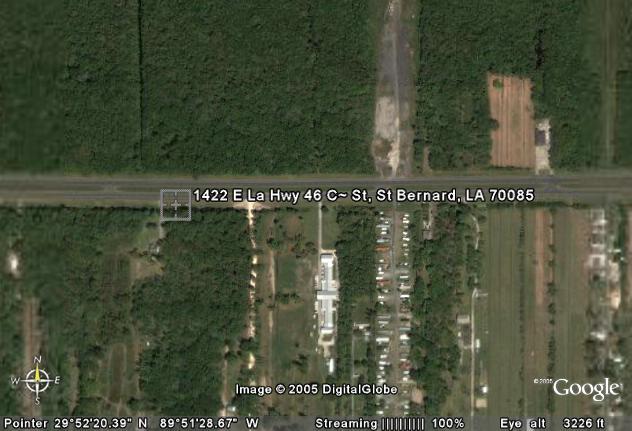
For those that don't know, this nursing home was actually on one of the state's official evacuation routes. Highway 46 runs directly adjacent to the nursing home and the home's address is given as Highway 46. The nursing home was in an excellent location in order to be evacuated in a timely basis. And yet, it was never properly evacuated before the storm, and efforts to move patients to higher ground once the storm hit was doomed to failure.

Here are the evacuation route maps Also, here's the parish evacuation plan.

Thus far, what is missing is how the state and local authorities are supposed to deal with evacuating hospitals and nursing facilities in the path of an oncoming storm and particularly those who aren't moving their patients to higher ground. These patients should be among the first moved out of the way of the impending storm - they are the ones least likely to survive a storm once it hits and power is lost, resources are slow to arrive, etc. Getting them to higher ground is better than hoping that you can ride out the storm in place.

Going forward, authorities must do a better job of evacuating patients from these facilities before storms hit so that they can protect the lives of those patients. The emergency plans must do a better job of clarifying when and where these facilities should be evacuated. This should essentially boil down to the following - if an evacuation has been called in your area - patients should be evacuated to the nearest safe haven.

In this instance, the owners should have known to get their patients to higher ground, especially after the phone call from the Coroner's office asking why the nursing home wasn't following their filed evacuation plan and utilizing the buses at their disposal, let alone the buses offered by the Parish.

Then, there's the Andrew Broussard angle. Broussard is the Jefferson Parish, LA president who made several emotional pleas on national television recounting the events surrounding the death of one of the patients at St. Rita's. From the 9/4/05 Meet The Press:
"The guy who runs this building I'm in, emergency management, he's responsible for everything. His mother was trapped in a St. Bernard nursing home and every day she called him and said, 'Are you coming, son? Is somebody coming?' And he said, 'Yeah, Mama, somebody's coming to get you. Somebody's coming to get you on Tuesday. Somebody's coming to get you on Wednesday. Somebody's coming to get you on Thursday. Somebody's coming to get you on Friday.' And she drowned Friday night. She drowned Friday night.""
Katrina hit August 29. The nursing home was flooded out on the 29th. The victim in question was the 92 year old mother of Thomas Rodrigue, who told Dateline that his 92-year-old mother was one of 32 elderly people found dead at the St. Rita’s nursing home. Meanwhile, Parish officials say that the victims all died on the 29th. As per NYT, and other media reports.

Wuzzadem suggests that political opportunism is at the heart of Broussard's claims. At this point, Broussard is suspect, and his behavior can be explained by political opportunism in the same vein as Nagin and Blanco.


See also:
The Criminal Horror of St. Rita's Nursing Home
The Horror at St. Rita's Nursing Home

UPDATE:
The LA Attorney General is examining additional claims against other La. hospitals and nursing homes to determine if additional criminal charges should be filed.

Did everyone forget that in case of a hurricane that you get everyone out of the way, including those in hospitals, nursing homes, and other similar facilities?
The Louisiana attorney general's office said all of its investigators have been pulled from other tasks to work on the Medicaid Fraud Unit, the team whose work led to homicide charges Tuesday against the husband-and-wife owners of the flooded-out St. Rita's nursing home in Chalmette.

Kris Wartelle, a spokeswoman for Attorney General Charles Foti, said the office is looking into other allegations of neglect that may have led to injuries or deaths at nursing homes and hospitals.

"Reports are flooding in. It just depends on what's legitimate and what is not," Wartelle said Wednesday.


Here's AG Foti's press release on the surrender of the owners of St. Rita's Nursing Home:
... [The] owners of St. Rita’s Nursing Home in St. Bernard Parish surrendered to Medicaid Fraud Control Unit Investigators in Baton Rouge today at 3:00 p.m. in Baton Rouge, Louisiana. St. Rita’s Nursing Home is located in Violet, Louisiana in St. Bernard Parish.

Mable B. Mangano, who is listed as both an owner and administrator and Salvador A. Mangano, Sr., listed as a co-owner, were arrested and booked into the East Baton Rouge Parish Prison as fugitives. Mable Mangano and Salvador Mangano, Sr., are each charged with 34 counts of negligent homicide.

Katrina Wednesday Roundup

Self interested Congressman uses National Guard to check on home:
Will Collier of Vodkapundit relates the story of a powerful Louisiana Congressman who took it upon himself to round up a bunch of Louisiana National Guardsmen to check on his house after making their way to the Superdome. The truck they were in got stuck in the flooding and needed to be resuced. The National Guardsmen signaled a Coast Guard rescue chopper but the good Congressman refused to be rescued twice. The original story.

Recovery efforts in Slidell are moving slowly.

St. Rita's Nursing Home criminal case proceeding:
In a follow up to my earlier pieces on St. Rita's Nursing Home, a 35th patient who was rescued from the rising floodwaters has died of injuries sustained and the pair of owners of the nursing home will be charged with a 35th count of negligent homicide by the Louisiana Attorney General. An MSNBC story says that the Attorney General will examine various reports of deaths at hospitals and nursing facilities to determine whether charges should be pursued.

This gets me to thinking. What does the emergency evacuation plans have to say about this. When a mandatory evacuation notice is given, and the nursing home or hospital is unable or unwilling to move patients, should the local authorities move in to get these people to safety.

I understand that the attorney for Mable and Salvador Mangano, the owners of St. Rita's is going to argue that moving their patients would possibly have resulted in their death due to their special needs. He's also claiming that hte Magano's were waiting for a mandatory evacuation order that never came.

This has a tinge of the truth to it. Some people are at a higher risk of death due to moving them when they're on ventilators, feeding tubes, or oxygen. I wont say that they did nothing, as it appears that some workers at the nursing home tried to barricade the lower floor to keep the floodwaters out, but were quickly overwhelmed by the storm surge. There was a near 100% risk of death or serious bodily injury for staying put.
The Manganos had an evacuation plan as required under state law, both their attorney and the attorney general said.

But Foti said the nursing home had a contract with an ambulance service to evacuate the patients, but the owners didn’t call the company. They also turned down an offer from St. Bernard Parish officials who asked if the nursing home wanted help evacuating, he said.

The victims died Aug. 29, the day the hurricane hit, and on Sept. 6, at least 14 unrecognizable bodies were still inside the nursing home, the New York Times reported last week.
It was absolutely inexcusable that they didn't even try to move at least some of these patients. Were all of them on ventilators or feeding tubes (special needs patients)?

While searching through the La. Attorney General's website for more information on St. Rita's, this release popped out. It states that Gov. Blanco and the Attorney General issued three executive orders on September 2, 2005. One of those orders was
Executive Order Number KBB 2005-31 pertains to the Emergency Evacuation by Buses.
• Parishes with running school buses must report to the Office of Homeland Security to help with massive evacuation of Hurricane Katrina evacuees.
Would it not have made more sense to issue this particular order before the hurricane hit, instead of after? By issuing this directive before the storm hit, it is possible that more people could have been moved out of New Orleans and other affected areas - and possibly preserved those buses and vehicles for use after the storm passed.

Mississippi Response:
Mississippi Governor Barbour expects to convene a special session of the legislature to address hurricane related issues.
A subcommittee of the House Ways and Means Committee looked at how local governments are being affected by the storm. Some reports cite municipalities, such as Waveland and Biloxi, that have lost most, if not all, of their local property tax base.

Hancock County Tax Assessor-Collector Jimmie Ladner estimated that his county had lost about 40 percent of its local tax base.

"I have people flat out telling me I can't pay taxes on a house that is not there - take it to the tax sale and see what you can get for it," Ladner said at the subcommittee hearing.

Ladner and other Gulf Coast officials said they would like to be able to "forgive" taxes for people who suffered major damage from the storm, but at the same time they need revenue to operate local governments and schools.
This is yet another way to measure the damage inflicted by Katrina - the total loss of a region's tax base. That means that the businesses, residences, and revenue generators for an entire region are simply no longer there. Wiped out by the storm.

However, even in Waveland, there are signs of hope.
“New Waveland Cafe” reads the large white sign prominently displayed under a tent where several volunteers are distributing water and lemonade.

Boxes nearby are overflowing with baby food, canned vegetables, peanut butter and other donated essentials at a one-stop shop where everything is free. Bottled water is stacked in towering piles, and the mound of diapers has grown so large that one volunteer said no more can be accepted because there is no room to store them.

By day’s end, members of the Christian Life Church from Orange Beach, Ala.—who have organized the relief efforts at this makeshift restaurant and supply distribution center in a Kmart parking lot—will have offered assistance to hundreds of Hurricane Katrina victims in Waveland, Miss.


UPDATE:
Confederate Yankee wonders why New Orleans Mayor Ray Nagin would buy a home in Dallas, Texas. Is he planning a move on a permanent basis? I've wondered about that myself. He can ostensibly claim that he was trying to make things comfortable for his school-aged kids, but I think it has to do with the end of his political career as a New Orleans and Louisiana politician. Either that, or setting up to be the next DNC Chairman if Howard Dean steps down.

Tuesday, September 13, 2005

The Criminal Horror of St. Rita's Nursing Home

Last week, I reported on the horror at St. Rita's Nursing Home. The situation is being investigated by prosecutors, who now are pursuing criminally negligent homicide against the home's owners.
The husband-and-wife owners of a nursing home near New Orleans were charged Tuesday with negligent homicide in the deaths of 34 people during the flooding unleashed by Hurricane Katrina.

The case represents the first major prosecution to come out of the disaster.

The owners of St. Rita's Nursing Home in Chalmette "were asked if they wanted to move (the patients). They did not. They were warned repeatedly that this storm was coming," Louisiana Attorney General Charles Foti said.

"In effect, their inaction resulted in the deaths of these patients," Foti said.

Salvador A. Mangano and his wife, Mable, surrendered and were jailed on 34 counts of negligent homicide. Each count carries up to five years in prison.

The attorney general said he is also investigating the discovery of more than 40 corpses at flooded-out Memorial Medical Center, in New Orleans' Uptown section.

The victims at St. Rita's died Aug. 29, the day the hurricane hit, and on Sept. 6, at least 14 unrecognizable bodies were still inside the nursing home, the New York Times reported last week.

St. Bernard Parish Councilman Ricky Melerine said the water rose 3 feet in 15 minutes that morning and then even faster, the Times said.

Several men tried to rescue the nursing home's residents by floating them out on mattresses, and others were able to walk to a school, the Times said. In all, the home had about 60 residents.

There were apparent efforts to fight the incoming water inside St. Rita's. A table was nailed against a window and a couch was pushed up against a door, the Times said. There was also evidence that water had reached the roof.

Thursday, September 08, 2005

The Horror at St. Rita's Nursing Home


That is a picture of St. Rita's Nursing Home before Hurricane Katrina. It is the long building on the right side of the image. The nursing home is now the scene of unimaginable carnage because the Home's residents were not evacuated before the storm. Searchers are now uncovering a horrible tale as they begin the grim task of recovering bodies from the scene.

LGF has more.

No one knows for sure why officials of St. Rita’s, a privately owned nursing home, chose not to evacuate. On Wednesday, officials were still unsure of the number of people who died there, but previous estimates put the toll at 30 or more.

“This is the worst thing I’ve ever seen, and I drug bodies to the levee after Hurricane Betsy,” said 60-year-old Raymond Couture, one of the rescuers searching St. Rita’s this week.
This suburban parish a few miles from downtown New Orleans was hit hard by Hurricane Katrina and the subsequent flooding. Officials have estimated that the parish’s death toll may reach 500.

Details of what happened at the facility are still sketchy, but the descriptions of what’s inside the single-story, football-field-size building horrify even hardened disaster veterans.
Sad to say, but this story is going to be repeated all throughout the Gulf Coast as rescuers get into the more remote areas and those areas that had been cut off by the storm.

Katrina Thursday Roundup

It seems that the media has had its fill of the Big Easy and are moving on to other areas of the Gulf Coast. We got to see Katie Couric rummaging through a destroyed house - well it looked like the house had been cut in half by the storm - showing the place in complete shambles.

Took you long enough to figure out that there was more to this disaster than New Orleans. And we now have yet another meme developing - people didn't get out of the way along the Gulf Coast because they were able to ride out Hurricane Camille and didn't think that anything could be worse than that storm.

They were wrong. Dead wrong.

It appears that Katrina's storm surge exceeded that of Camille, and that the storm surge went more than 2 miles inland, which is an incredible indication of the power and fury of this storm.

Once again, it is another powerful reminder that when forecasters say that a storm can produce catastrophic conditions, you must get the hell out of the way. Even in a developed country, not much can withstand the force of such a monster storm.

The Mayor of Pascagoula, MS is concerned that FEMA has overlooked his city.
The destruction here is substantially less severe than in Biloxi, Gulfport or Waveland to the west along Mississippi's Gulf Coast. And it's far less extreme than the humanitarian crisis in New Orleans.

Still, Mayor Matthew Avara said he's worried that his city is being overlooked by FEMA.

"Right now, our biggest problem is FEMA and getting the FEMA trailers in" to house the homeless, said Avara, sworn in two months ago and now forced to run his government from a city maintenance building.

Avara said he fears that FEMA's resources were exhausted by Hurricane Ivan last year. "I know a lot of the trailers are still in use in Alabama and Florida," he said.

FEMA representatives were supposed to arrive here Tuesday to begin processing applications for housing assistance, Avara said. "We found a facility, put tables in, got electricity and got the Internet," he said. "Then we were told Monday night that a decision had been made and they would be here on Friday."

Mary Hudak, a FEMA spokeswoman, took issue with Avara.

"My guess is the mayor probably misunderstood," she said. Hudak said FEMA opened a disaster recovery center in Jackson County on Tuesday and will open another Friday. "FEMA's presence has been very strong in Jackson County. That is evident in the bags of ice, bottles of water, the plastic tarps and the meals being distributed throughout the community."
Last year, FEMA had to address four hurricanes hitting the Continental US, with significant damage to many areas of the Southeast and particularly in Florida. Resources that could have been devoted to Katrina relief are still in use in Florida because of the housing shortage in the way of the 2004 hurricane season.

The USS Comfort, one of two hospital ship in the US Navy, will be moored in Pascagoula to provide relief. The article specifically names two other Navy ships providing direct assistance to Mississippi - the USS Harry S Truman (an aircraft carrier), and the USS Bataan - an amphibious troop carrier. Both have the capability to field numerous helicopters which are crucial for search and rescue in remote areas where access from the ground is limited.

Northrup Grumman is hoping to get its shipyard in Pascagoula up and working by next week. They're busy cleaning up the damage and hoping to get back in business; the region needs this badly:
Los Angeles-based Northrop Grumman has three Gulf Coast yards -- in Pascagoula, Gulfport, Miss., and New Orleans -- that build ships or sections assembled elsewhere.

They sit within about 110 miles of one another, the largest being Pascagoula's 800-acre facility.

Including an onshore facility, the defense contractor employs close to 19,000 people in the Gulf region, which accounts for nearly 10 percent of its annual business.

The regional impact is significant. Northrop Grumman's average Gulf operations payroll is about $17 million a week, Cullin said.

Pascagoula has the highest profile among the three shipyards. Here, the company builds four classes of vessels for the U.S. Navy and Coast Guard. It competes with Maine's Bath Iron Works for defense contracts for Navy destroyers.

Nearly every worker who reported to the shipyard was put on clean-up duty. Jackie Robinson didn't want to drive the Caterpillar front-end loader, but he understood that he had no choice.


Cable companies struggle to restore service throughout the region.
"I've heard most of Pascagoula is up, Ocean Springs is on its way, and Biloxi is working to come back," Perry said, from behind his desk in a Long Beach office, his post-Katrina home for 10 days.

Cable One covers most of the Coast, from Diamondhead to Pascagoula, and Perry said the plan is to follow power trucks down cluttered streets.

"Power guys are doing a great job, and we're following them, hopefully to have cable restored as soon as the power comes back," he said.

Perry said the company has suspended billing for this month, even for customers who already have cable, and those who had receivers, remote controls or other equipment smashed to bits by Katrina's muscle will not be charged.

Cable One has contracted part of the restoration work to MasTec, a group of project managers used in New York City after 9-11 and in other hurricane riddled parts of Florida.

MasTec will conduct assessments of the damage and help tweak the logistics of the project.


Actor Matthew McConaughey has been working to rescue animals that were left behind as people were forced to flee for their lives or were told that shelters would not accept pets. He's been working in the Slidell area.

UPDATE:
Jack Shafer of Slate suggests that we should not rebuild New Orleans. More than a few politicians have floated that idea, including Denny Hastert, who got a prompt browbeating from the media and former New Orleans residents who consider anything less than a rebuilding to be blasphemy.
The police inspire so little trust that witnesses often refuse to testify in court. University researchers enlisted the police in an experiment last year, having them fire 700 blank gun rounds in a New Orleans neighborhood one afternoon. Nobody picked up the phone to report the shootings. Little wonder the city's homicide rate stands at 10 times the national average.

This city counts 188,000 occupied dwellings, with about half occupied by renters and half by owners. The housing stock is much older than the national average, with 43 percent built in 1949 or earlier (compared with 22 percent for the United States) and only 11 percent of them built since 1980 (compared with 35 for the United States). As we've observed, many of the flooded homes are modest to Spartan to ramshackle and will have to be demolished if toxic mold or fire don't take them first.

New Orleans puts the "D" into dysfunctional. Only a sadist would insist on resurrecting this concentration of poverty, crime, and deplorable schools. Yet that's what New Orleans' cheerleaders—both natives and beignet-eating tourists—are advocating. They predict that once they drain the water and scrub the city clean, they'll restore New Orleans to its former "glory."
Meanwhile, Witold Rybczynski examines the usefulness of temporary housing. He suggests that many people don't want temporary housing, but to go home. Here, we're going to find that many homes simply don't exist and are uninhabitable due to flooding, contamination, and structural failure. However, he notes:
This needs to be borne in mind in the context of the current total evacuation of New Orleans. According to Davis, "all evidence from World War II onwards indicates the failure of [compulsory evacuation]." Certainly, the situation in New Orleans poses more immediate health and logistical challenges than most disaster areas do: The water must be drained, and critical infrastructure repaired before people can live there safely. But the bureaucratic impulse to keep all citizens out until this work is completed should be resisted. People must be let back into the city, or parts of it, as soon as possible; Mayor Ray Nagin is right about that. There is already anecdotal evidence being reported that some evacuees are considering settling down in Houston, or Dallas, or San Antonio, and not returning home.

What Davis' work also suggests is that most of the rebuilding of New Orleans will not be done by government but by the private sector, much of it by small contractors, do-it-yourselfers—and volunteers. Americans, more than most, are a nation of handymen. Their individual spirit of improvisation and inventiveness must be allowed to do its part.


UPDATE:
MSNBC has discovered the rest of the Gulf Coast as well. Mississippi expects to have power restored to all businesses and homes capable of receiving power by Sunday. That's a pretty impressive feat. Consider all the debris that had to be cleared just to get crews in to install new poles and run new lines. In many areas they had to rebuild the grid from scratch.

Meanwhile, folks are poking around what the Army Corps of Engineering has been up to. They've been plenty busy, but not necessarily on flood control.
Before Hurricane Katrina breached a levee on the New Orleans Industrial Canal, the Army Corps of Engineers had already launched a $748 million construction project at that very location. But the project had nothing to do with flood control. The Corps was building a huge new lock for the canal, an effort to accommodate steadily increasing barge traffic.

Except that barge traffic on the canal has been steadily decreasing.

In Katrina's wake, Louisiana politicians and other critics have complained about paltry funding for the Army Corps in general and Louisiana projects in particular. But over the five years of President Bush's administration, Louisiana has received far more money for Corps civil works projects than any other state, about $1.9 billion; California was a distant second with less than $1.4 billion, even though its population is more than seven times as large.
It's all about priorities. Corps projects are a great way for politicians to show they've brought home money, but does anyone really take a good look at what that money is spent on?

Facts will out, and it wont be pretty.

UPDATE:
LGF relates a story from The Dallas Morning News that goes beyond ugly. A nursing home in St. Bernard Parish apparently never evacuated, even though parish officials had sent a bus to help evacuate the residents. No one knows why the offer of assistance was turned down, but it appears that many of the residents were killed by the storm and its aftereffects.
St. Rita's had the required evacuation plan: Ambulances would be called to take bedridden patients away, and the others would be evacuated by school buses. At least 60 patients and six staffers may have been in the building when Katrina hit.

Parish coroner Dr. Bryan Bertucci said several of the parish's other nursing homes evacuated during the weekend, but St. Rita's staffers never put their plan into effect.

Sunday afternoon, Dr. Bertucci said, he checked with St. Rita's staff to see why. He said the owner, Mabel Mangano, told him she had five special-needs patients, and an ambulance hadn't come to pick them up. Officials said she also told them that she had spoken with the families of patients who said it was okay to stay behind.

"There was frustration over not having her patients out; a false sense of security because they'd never flooded before; they had generators and stuff, and it [an evacuation] tends to be traumatic for some of these special-needs patients," Dr. Bertucci said.

"She asked me if we were upset," Dr. Bertucci said. "I said I'm not on the council, I'm concerned about the patients."

Dr. Bertucci said he told Ms. Mangano, " 'We've got two buses and two drivers that'll take you anywhere you want to go. Do you want the buses?'

"She said no."


UPDATE:
I have set up a seperate entry for St. Rita's Nursing Home.

In Mississippi, history is a salvage job. Cleanup includes trying to salvage the remnants of a grand antebellum past. Huge plantation estate buildings were devastated by Katrina, including the home of Jefferson Davis:
THE barrel of the Confederate 12-pounder howitzer was missing, and so was the saddle on which Jefferson Davis rode into the Mexican War. Four days after Katrina, Patrick Hotard's face was shadowed with exhaustion and dismay as he surveyed what was left of Beauvoir, the beachside Jefferson Davis home and presidential library, where he is the director. He had just arrived from his refuge in Louisiana, and many of his worst fears were being confirmed as he picked through the bricks, giant wafers of plaster and nylon Confederate flag replicas.

"Devastated," Mr. Hotard said, a hand on his forehead. "It's a real feeling of emptiness." Beauvoir is not just his personal address - he and his family lived in a house now vaporized on the 51-acre site, which is owned by the Mississippi division of the Sons of Confederate Veterans - but his life's work.

Some $220,000 had just been spent renovating the graceful gallery porches and the entrance doors, each with its nine oval panes, of the 1852 Greek Revival house where Davis, the Confederate president, spent his last 12 years. Those features are now either gone or in ruins, along with two original porch-wrapped cottages, a replica of a Civil War barracks and the entire first floor of the presidential library.

Mr. Hotard is one of the many curators, archivists and preservation advocates who are beginning to tally the losses in the areas hardest hit by the hurricane, even as emergency workers turn to the more essential tasks of gathering the dead and providing supplies. For preservationists in Mississippi no less is at stake than the region's architectural patrimony.
We have lost a big piece of American history along with everything else. Historians will have a tough time trying to piece together the collection, but many items have been lost.

Slidell, LA businesses are assessing the damage and are starting with the basics - who was available to work. With communications spotty, getting in touch with businesses is tough. Contractors are going to be in incredible demand, but they have to have an available workforce to do the work. That takes time, and those workers have to have a place to stay too.

Emeril Lagasse, the famous chef who calls New Orleans home, is helping his workers try to find work at his other restaurants all while providing continued direct deposit paychecks to employee accounts:
"Due to conditions in New Orleans, we do not know at this time when the restaurants will be able to be reopened," the site said. "We are making efforts to employ New Orleans employees at other locations, where possible."
Good on him!

UPDATE:
Does anyone in the media know what's going on in Kenner, LA? Apparently not many are asking that question. I see a story about flooding continuing to be a problem for a manufacturing plant and a slightly older one that talks about the economic hit to the region (New Orleans, Metairie, and Kenner corridor).